02.Kyoto and Christianity
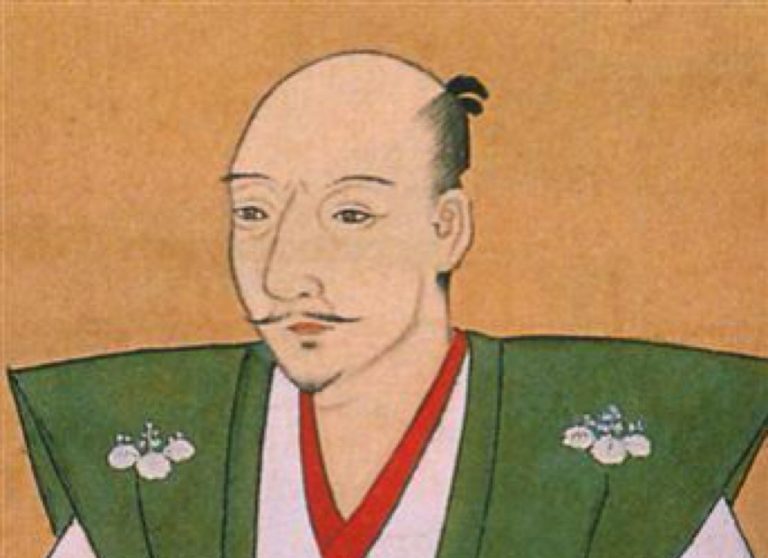
Nobunaga Oda
1.Nobunaga Oda and his protection of Christianity
The history of Christianity in Kyoto begins in 1549 when Francis Xavier landed in Satsuma on the southern tip of Japan. Many more missionaries followed Xavier and conducted missionary work in Japan, and gradually spread under the protection of Nobunaga Oda, the ruler of Kyoto at the time.
2.Why did Christianity spread?
Xavier was a missionary from Portugal. But missionaries were also like diplomats, as well as tradesmen. They were regarded as elite intellectuals. If Japan wanted to trade with Portugal, it had to negotiate for permission through the missionaries. As Japan deepened its relationships with Christianity, its ability to trade with Portugal and acquire weapons also increased. By developing his relationship with Christianity, Nobunaga not only benefitted economically by importing and selling foreign silk, he was also able to obtain military supplies such as saltpeter, the raw material for gunpowder, and lead, which made the bullets. In return, Jesuits were granted permission to live in Kyoto, construct churches, and conduct missionary work under this arrangement. In a sense, it was quite an effective win-win relationship between Nobunaga and the missionaries.
Missionary activities in Kyoto began in earnest around 1559. However, this was during the Sengoku Period of Japanese history. The church in Kyoto was destroyed in the warring, and missionary work made slow progress. However, this changed when Nobunaga entered Kyoto in 1568 and seized power, becoming the de facto ruler. In addition to controlling the Buddhist groups that were his main opposition at that time, protecting Christianity allowed him to take advantage of foreign trade. With the preferential treatment afforded by Nobunaga, missionaries such as Organtino expanded their activities in Kyoto, constructing new churches and chapels, and Christianity in Kyoto reached its peak. Many missions called Nanbanji were built in various places around Japan, but none was more important than the one built in Kyoto, the capital of Japan at the time.
The figure below shows a map of Nanbanji, on display at the Kobe City Museum. It was the first Christian place of worship in Kyoto. Built in 1561, it was a three-story cathedral built by the Jesuits as base for missionaries in Kyoto, with the understanding of Nobunaga. The church was devastated, but rebuilt in 1576, and became a popular landmark in Kyoto. The surrounding area became known as “Daiusu Town” after Deus, which means God. Records state that hundreds of Christians held mass at this location.
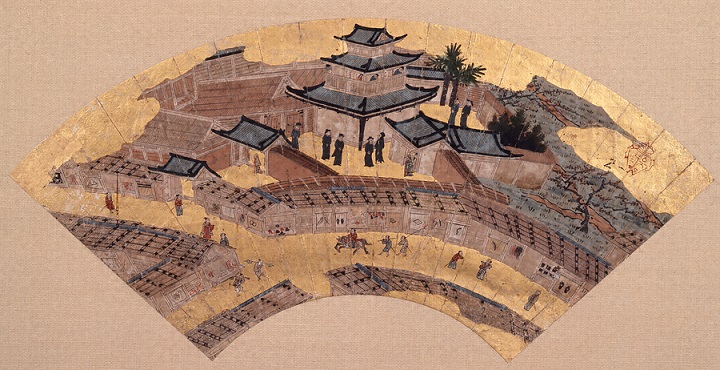
Nanbanji Temple (Kobe City Museum)
3.Repression of Christianity by Hideyoshi Toyotomi
Christian missionary activities flourish under Nobunaga’s protection. However, this changed and Christianity faced a crisis when Hideyoshi Toyotomi and Ieyasu Tokugawa came to power and took the opposite stance, persecuting and repressing Christianity. In the history of martyrdom in Japan, there are three significant events known as the Great Martyrdom of Japan: the Great Martyrdom of Nagasaki in September 10th, 1622, the Great Martyrdom of Edo in December 4th, 1623, and the Great Martyrdom of Kyoto, of October 6th, 1619.
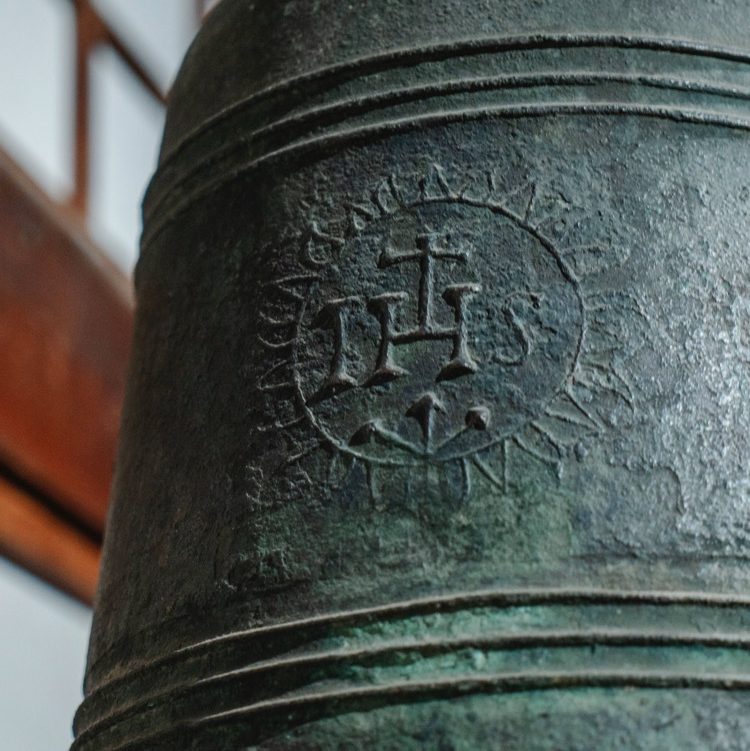
Hideyoshi Toyotomi, who was the successor to Nobunaga, issued the Batteren Edict expelling Jesuit missionaries in 1587. From this point, Christianity experiences an era of exile and repression. Hideyoshi served Nobunaga, succeeded him, and brought national unity in 1590. There are mayny reasons for Hideyoshi’s persecution of Christianity. The fear that Spain and Portugal would one day invade Japan, and that Christians would become an antigovernment force, are some. As a part of his crackdown on Christianity, the Nanbanji Tempe in Kyoto was destroyed. Artifacts such as foundation stones, furnace flues, and inkstones were excavated from the site and are now displayed at the history museum of the Imadegawa Campus of Doshisha University. In addition, the bell which is thought to have been hung at Nanbanji Temple is currently hung at Shunkoin Temple at the head of the Myoshinji Temple, and has been designated as Important Cultural Property. It is a European-style copper bell and bears the Jesuit coat of arms, the Christian cross, the letters HIS, and the number 1577. IHS stands for “Iesus Hominum Salvaor” which means ‘Jesus, the savior’ in Latin.
Although this section is about Hideyoshi’s persecution of Christianity, this was not always the case. According to one theory, Hideyoshi was moved to his stance when he visited the Kyushu region of western Japan in 1587, right before the unification of Japan. There, he saw the Portuguese forcibly converting Japanese people into Christianity. He also heard that they were trading Japanese people as slaves. So, he issued a deportation order in 1587, saying that Japan is a Buddhist country and spread of Christianity is inappropriate in such a country. Missionaries were required to leave the country within 20 days. However this order was not a practicable one for many reasons, not the least of which was the fact that Hideyoshi’s assistant was a Christian. In fact, Hideyoshi often showed a willingness to work with Christianity, even after the expulsion order. For example, he was supportive of missionary work when he granted Franciscan Father Petro Baptista permission to preach freely in 1593. He also allowed construction of St. Mary’s Church, hospitals, schools, and the Spanish embassy.
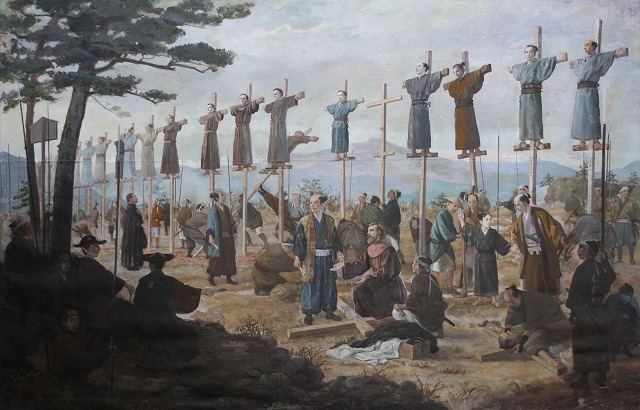
However, Hideyoshi renewed the prohibitions on Christianity in 1596, and executed the Franciscans that were active in Kyoto. The story goes, the Spanish sailing ship San Felipe washed ashore in 1596. When they were rescued, one of the sailors said, “Spain is planning to conquer Japan, and the missionaries are the spearheads,” triggering the second prohibition order. Using the words of the sailor as proof of his fears, Hideyoshi began his persecution of Christianity in earnest and in 1597, Christian missionaries such as Father Baptista were captured. Hideyoshi gave them the death penalty. Their nose and ears were cut off and they were forced to walk around the city of Kyoto. Then, they were taken to Nagasaki, which had a large Christian population, to be crucified. Mitsunari Ishida, the shogunate administrator at the time, who had some sympathy for the Christians, slightly changed the order out of mercy so that only one ear was cut off. However, in order to humiliate the captives according to the customs of the time, the 24 missionaries were laid down in cow carts around the city. After that, they were transported from Kyoto to Nagasaki on foot. Two believers joined them along the way, bringing the total to 26. Upon arrival in Nagasaki, they were all burned at the stake and executed. Most of the 26 martyrs were active in churches and other facilities near Myomanji Temple.
4.Repression of Christianity by Ieyasu Tokugawa
After the death of Hideyoshi, Ieyasu ruled the land. Missionaries sought permission from Ieyasu to recontinue missionary work and rebuild their temples. Ieyasu came to power after defeating Mitsunari Ishida, who was known to have Christian sympathies, in the battle of Sekigahara in 1600. But he showed a somewhat friendly attitude towards the Christians at first. The Keicho Tenshodo, a beautifully built western-style building constructed in 1604, during Ieyasu’s time. It is reported that missionaries were stationed there, and held majestic masses every day. However, as with past rulers, fears of Catholic countries invading Japan grew beyond containment. In 1612, Ieyasu once again banned Christianity from Japan. The clampdown began in Edo in 1612, and spread to Kyoto the following year. The Keicho Catholic Church was destroyed, having stood for less than 10 years. This was a familiar story that represented the fate of Christians in Japan well, being at the complete mercy of those in power at any given time.
The 1619 martyrdom was the greatest assault against Christians in Japan took place during the reign of Ieyasu’s son, Hidetada. Sixty-three believers were captured and imprisoned in the Ogawa Prison. It is said that eight of them died in captivity due to the terrible conditions in the prison. Hidetada, shogun at the time, ordered all believers to be burned at the stake when he learned that several Christians were hiding at Fushimi. On October 6th, 1619, 52 Christians in total were gathered along Rokujo River, including 11 children, some of whom were under 2 years old. Among the many families executed that day, the fate of Tecara and his family especially brought tears to people’s eyes. Tecara had five children. With a 3-year-old in his left arm, his right arm around his 12-year-old, and 2 other children crucified on separate crosses, the execution started. As the fire was lit and logs started to burn, Tecara continued to comfort the children, telling them they will be delivered to God soon, through the flames and smoke to his last breath. A memorial stone was placed on the bank of the Rokujo River as a memorial to the execution.
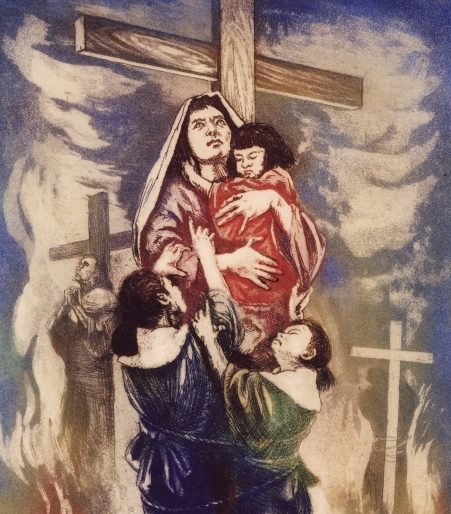
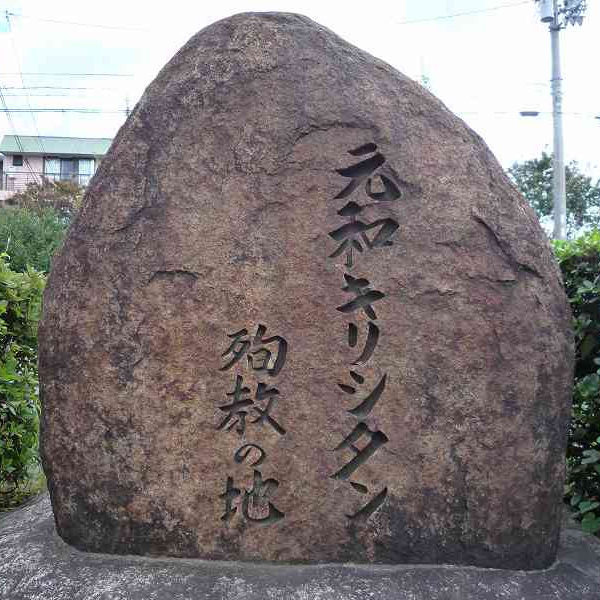
A memorial stone was placed on the bank of the Rokujo River
5.Secret-Christians
Public displays of Christianity all but disappeared. Some continued to worship in secret, sometimes worshipping “Maria Kannon” which were statues of Mother Mary that resembled the Buddhist Kannon statues. These worshippers were called crypto- or secret-Christians.
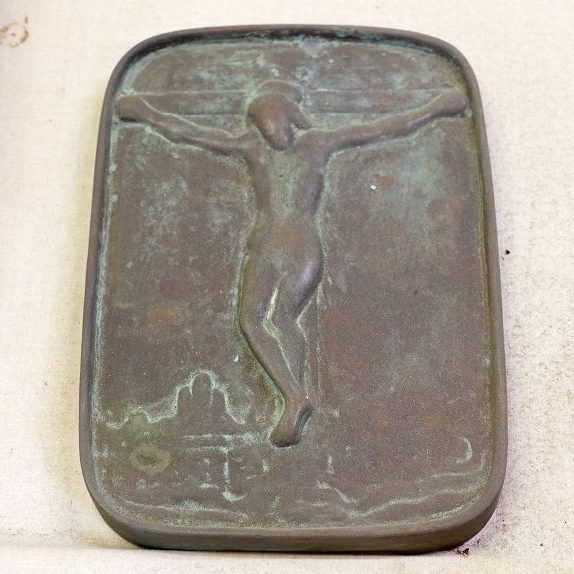
In the western most city of Nagasaki, “fumi-e” was used to root out the crpyto-Christians. The 3rd shogun, Iemitsu Tokugawa, took an even harder line against Christianity, and Nagasaki had a particularly high population of Christians at the time. “Fumi-e” literally translates to “image to be stepped on.” It was a metal plate with an engraving to Christ and the Virgin Mary for people to step on. Of course, this would be sacrilege to any believing Christian. Any person who was not able to step on the engraving was determined to be Christian. They were asked to either abandon their faith, or be executed. As such, Christianity was at the mercy of whomever was in power. This was true not only in Kyoto, but throughout Japan.
This brings us to the end of this section. Unfortunately, many Christian landmarks have been destroyed over the long periods of persecution, and few remain today. However, some tombstones were found in Kyoto. The Kyoto National Museum has a tombstone on display in the garden, which can be visited at any time.

NATIONAAL MUSEUM VAN WERELDCULTUREN