03. Buddhism
History of Buddhism
Buddhism originated in India and travelled various routes through Southeast Asia, China, and the Korean Peninsula before being introduced to Japan. Its history goes back over 2500 years. It all began with Prince Gautama. Born in a Kingdom in what is now Nepal, the prince was later called Gautama Siddhartha in the local language, which meant ‘successful’. At the age of 29, Siddhartha Gautama abandoned his throne and embarked on a journey in search of an answer to the question, ‘How can one have a happy life, and a peaceful death?’ He traveled 500 km to the south, and in the mountains of the tributaries of the Ganges River, trained his mind with extreme rigor. Old scriptures attest to the scope of suffering he imposed on himself, stating, ‘The skin of my belly became so stuck to my spine that when I thought of touching my belly, I grabbed hold of my spine as well.’ After 6 years of such training, Siddhartha realized that, ‘it is not good to do anything in the extreme; the middle path is right.’ This idea of the Middle Path became the foundation of subsequent teachings of Buddhism.
Having trained his mind and endured such hardships, Gautama Siddhartha became enlightened at the age of 35. To be enlightened means to be awakened to the true state of reality, allowing one to be freed from the anxieties of desire, anger, and even stupidity. The enlightened Gautama Siddhartha became respected around the world as a priest and eventually became known as the Buddha. For 45 year, from when he became enlightened at the age of 35 until his death at the age of 80, he travelled across northern India to spread his word. This was the beginning of Buddhism.
Changes through the ages
Shinto is an ancient Japanese ethnic religion that continues to permeate facets of everyday life, even today. On the other hand, Buddhism is a religion that originated in India and influenced as it made its way through Southeast Asia and China, before it was introduced to Japan in 583. These two religions have coexisted until today. The characteristics of Buddhism and its practices changed over the ages in Japan.
Buddhism During the Nara Period
The period from 710 to 794 is known as the Nara Period. During this time, Buddhism itself was seen as an advanced culture, and was a status symbol. Monks held status as bureaucrats and were respected as intellectuals who were fluent in many foreign languages. At that time, China was one of the most developed countries in the world and had advanced and sophisticated culture and political system. Many Japanese elites, like Emperors and monks, were fascinated by modern Chinese-style Buddhist buildings, tall pagoda towers, and golden Buddha statues. Many people of influence built temples and prayed for the prosperity of their households. At the same time, this was a way to show off their financial strength. Fundamentally, Buddhism is a religion that teaches believers how to reach the truth of existence through the abandoning of worldly desires. This was not understood by the practitioners at the time.
Buddhism during the Heian Period
The period from 794 to 1192 is known as the Heian Period. At the end of the Nara Period, some monks started abandoning the secular application of Buddhism. Saicho and Kukai are well known monks in Japan. They were members of an elite class of monks and were on a high career track, even studying Buddhism abroad in China. They would both leave their promising careers and head for the mountains. They built a temple on a mountain that was considered to be pure and sacred. Here, a new type of practice called Esoteric Buddhism was born. This employed secret mantras that require great effort to learn and was used to pray for national peace and security, and ultimately achieve enlightenment. Wanting to experience the miraculous benefits of Esoteric Buddhism, the Imperial Court and many aristocrats often asked monks in Mt. Hieizan and other temples to recite incantations for them. They made large donations and asked for prayers for everything from rain, cure for diseases, career advancement, and even fulfillment of love. The temples grew very large over time, and accumulated huge wealth, mostly through the ownership of large swaths of land. In addition to scripture, the monks also studied medicine, pharmacy, architecture, engineering, military strategies, agriculture, industry, and many other fields. Large temples, such as the Hieizan Temple, were much like university campuses of today. Sometimes, the children of aristocrats would enter the temples, not to become monks, but to study various subjects. So, they were limited to the most influential families of the area. On a side note, famous European universities such as Oxford and Cambridge also grow out of medieval monk seminaries that had very similar characteristics to these Japanese temples. Similar to today, influential temples were very expensive to attend.
Buddhism during the Kamakura Period
The period from 1192 to 1333 is known as the Kamakura Period. Here, a new type of monk appeared. They were not like the bureaucrats that prayed for the state as in the Nara Period. Nor were they like the monks that served the aristocrats in the Heian Period. These were people who tried to return to the original form of Buddhism. Monks and temples left the control of the government and turned their attention to relieving the souls of vulnerable people, and society at large. Social unrest was increasing during this time due to the long-lasting war. Due to their immense suffering and hardship in this world, they hoped for salvation in the afterlife. During the Heian Period, Saicho and Kukai attained enlightenment through rigorous and dedicated training. However, ordinary farmers did not have the time, resources, or patience to carry out such training. 6 new sects of Buddhism such as Jodo Sect, Jodo-shin Sect, Ji Sect, Nichiren Sect, Rinzai Sect, and the Soto Sect were born to meet the needs of the general public. These new styles did not require any difficult study or training. It only required believers to recite a Buddhist chant and pray with all their heart. Due to its simplicity, these new styles spread quickly through the masses, and have legacies even to this day. To take the Jodo Sect as a simple example, it is said that one can spend eternity in the paradise of Amida Buddha simply by chanting ‘Namu Amida Buddha.’
Buddhism in the Sengoku Period
Let’s take a look at Buddhism in the Sengoku Period. ‘Sengoku’ translates to ‘Warring Country’ and the Sengoku Period lasted from the end of the 16th century well into the 17th century. It is no exaggeration to say that the history of Japan is the history of war. While wars and invasions from foreign countries was rare, Japanese history is filled with constant domestic conflicts that continued for centuries, with many large decisive battles.
Samurai during this period often went into battle with Buddhist teachings written on their clothes under their armor, and small amulets of the Buddha on their person. They knew well of the ghosts of fallen soldiers lurking on the battlefields, and prayed for the blessing of the Buddha so that a spear or arrow would not lead them to the same fate. Warlords cherished the Buddha and build temples in their territories, and rebuild dilapidated ones.
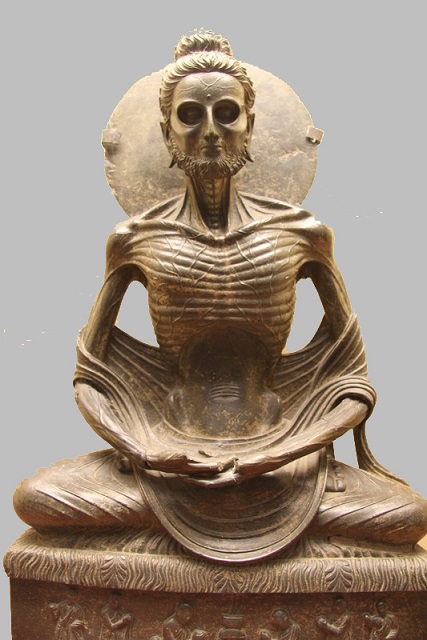
Gautama Siddhartha
How to look at a Buddhist statue
Buddhist statues are broadly divided into four groups: Nyorai, Bosatsu, Myo-o, and Tembu, making up a pyramid structure. Each group has a wide variety of Buddha images. For example, in the Nyorai group, there are many kinds of Buddha such as Dainichi Nyorai, Shaka Nyorai, Yakushi Nyorai, and Amida Nyorai.
1. Nyorai
The main members of the Nyorai group include Dainichi Nyorai , Shaka Nyorai , Yakushi Nyorai , and Ami da Nyorai . The Nyorai is a representation of a monk who ha s endured severe ascetic practices and attained enlightenment with h umble robes and no jewelry. The white hair on the center of forehead and coiled hairs represent the superhuman characteristics that are said to have resulted from enlightenment. In addition, the shape of the hands has meanings described below.
Main features of the Nyorai
Spiral hair: Each hair on the head is spiraled clockwise into a mass.
Bump: Each hair on the head spirals around to the right and forms a mass. A sign that the head is full of enlightened wisdom.
White hair: A curled white hair in the center of the forehead. It spirals in a rightward direction. It radiate light to illuminate the world.
Hand shape: The shapes of the hand have meaning.
○Shaka Nyorai
Shaka Nyorai is t he first basic image of Nyorai in the beginning of Buddhism history. From this basic image, various Nyorai images were derived according to the purposes people wished for.
○Yakushi Nyorai
Characteristic of this statue is that it holds a pot of medicine. This Buddha image was created to pray for protection from illness and bad luck.
○Amida Nyorai
This Buddha is said to lead the people to the Pure land the Buddhist paradise by simply chanting ‘Namu Amidabutsu’. It is said that when a person dies, there are nine levels of treatments depending on people’s beliefs and deeds before death . Amida Nyorai forms its hands into nine patterns.
○Dainichi Nyorai
Dainichi Nyorai a representation of the universe itself, and all other Nyorai , including Yakushi Nyorai and Ami da Nyorai , are transformed from of Dainichi Nyorai.
Explanation of the Merits of Nine Types of Hands
The Vairocana Buddha is famous for being the massive statue in Nara. The Vairocana Buddha often looks similar to Shakyamuni Buddha, making it sometimes difficult to distinguish between the two. This is because Vairocana Buddha is considered the true form of Shakyamuni Buddha, and you can see many Buddhas on the lotus pedestal and behind him. Each petal of the lotus represents a universe, and it is believed that there is a Shakyamuni Buddha in each one.
Generally, Buddha statues have 32 distinct features. Each feature has its own significance.
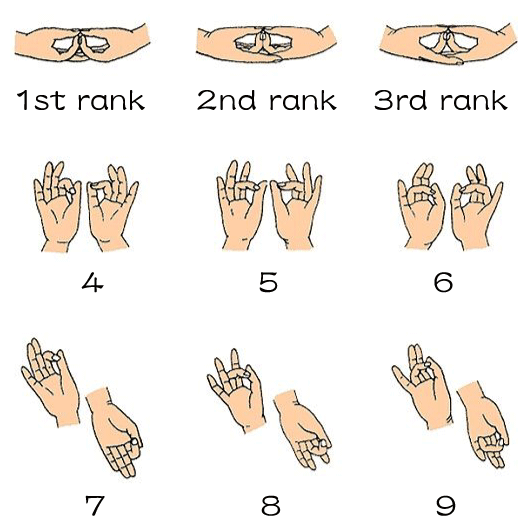
9 shapes of hands (Amida Nyorai)
2.Bosatsu
Bosatsu is a deity that attends on a Buddha, the primary deity. The main Bosatsu include the Sho-kannon, the Eleven-faced kannon, the Thousand-armed kannon, and the Jizo Bosatsu. In contrast to the already enlightened Buddha, Bosatsu represent monks who are still in training. Bosatsu have a neutral appearance, wearing glittering ornaments and having their hair tied up. Bosatsu are usually depicted aloof so that they can immediately go to the aid of those who seek help. There are two types of Bosatsu: Kannon and Jizo. Kannon is the one who leads us into a higher realm, while Jizo lives in the hell world and saves people who have fallen into hell after death. The Jizo Bosatsu was born out of the fear of hell.
○Sho-Kannon
This is the basic form of Bosatsu. As time went on, it changed into 33 types of Bosatsu with superhuman characteristics such as Eleven-faced Kannon and Thousand-armed Kannon.
○Eleven-faced Kannon, Thousand-armed Kannon
The eleven-faced Kannon has eleven faces on its head and watches in all directions in order to quickly find those who are suffering. The thousand-armed Kannon, on the other hand, save all the people in the world with a thousand hands. In reality, most statues have only 42 hands instead of 1000, but there is an exception at Juhouji Temple in Kyoto, where there is actually a Kannon with 1,000 hands.
○Jizo Bosatsu
Bosatsu is represented by a bald head, the form of a monk. Jizo Bosatsu is thought to turn itself as a substitute for people who had fallen into hell.
3.Myo-o
Myo-o’s appearance is in anger surrounded by flames of fire, wearing ornate ornaments and holding a weapon. While the Buddha and Bosatsu admonish people with compassion and mercy, the Myo-o is the one who saves the people by force. With Fudo Myo-o, who is blessed with prosperity in business, at the center, there are four Myo-os guarding the east, west, south, north, and south directions. Each Myo-o has different grace.
○Fudo Myo-o
As a servant of Dainichi Nyorai, the cosmic being of Buddhism, it is said that Dainichi Nyorai himself changed his form into Fudo Myo-o in order to save people who do not believe in Buddhism.
○Kouzanze Myo-o
Kouzanze Myo-o
guards the east, has the benefit of eradicating vexations.
○Gundari Myo-o
Gundari Myo-o
guards the south, has the power to correct wrong thinking.
○Daiitoku Myo-o
Daiitoku Myo-o
guards the west, is beneficial for victory in battle.
○Kongoyasha Myo-o
Kongoyasha Myo-o uards the north, is blessed with good health.
4.Tenbu
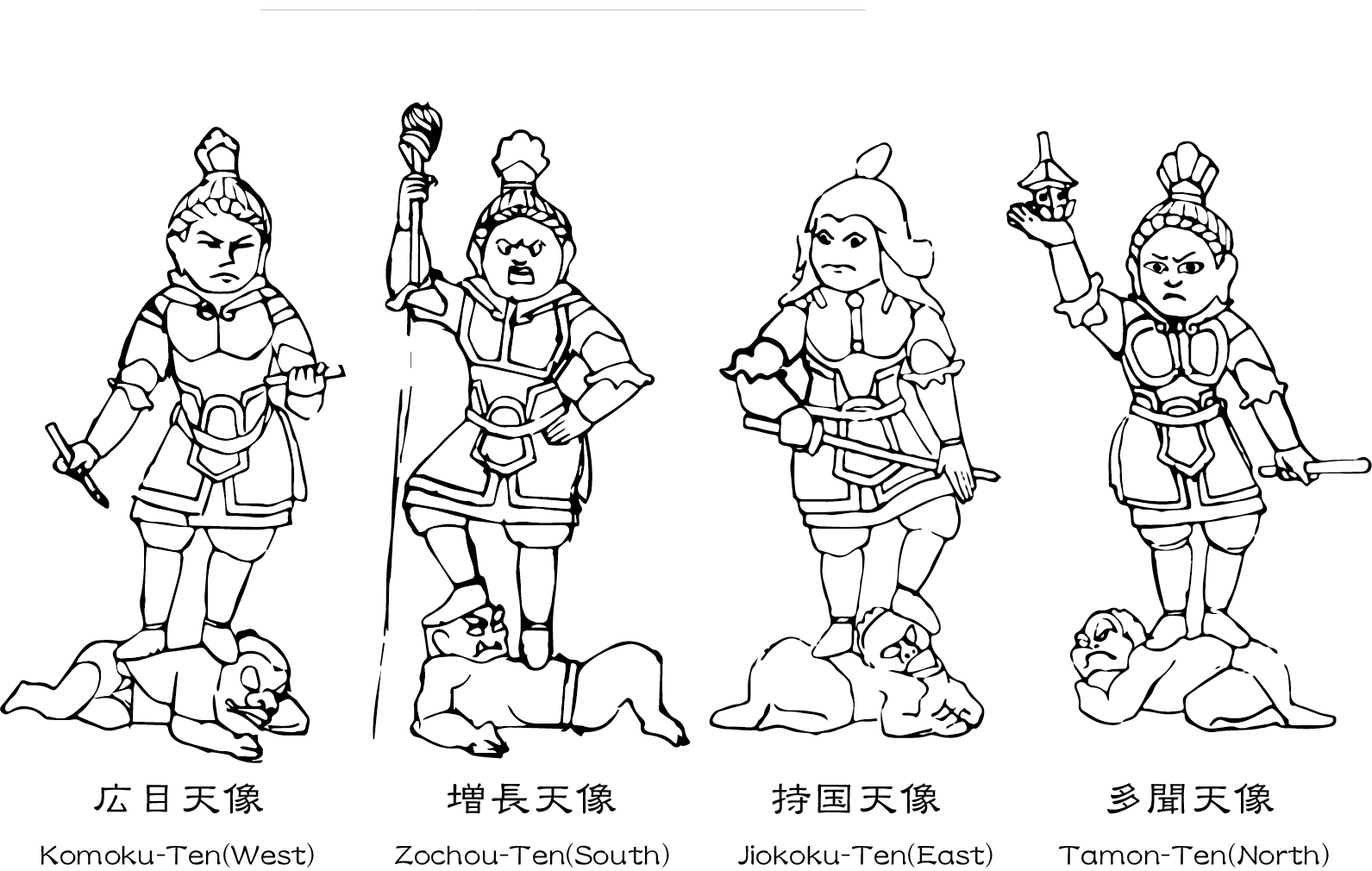
There are more than 200 types of deities in the Tenbu, and they are placed under the Buddha, Bodhisattvas, and Myo-o. There are more than 200 different types of deities. The two main types are the noble and armed bodies, but they do not share a common appearance. This group includes deities such as Bonten and Taishakuten, who were introduced into Buddhism at an early stage, as well as the Four Heavenly Kings that is familiar to Japanese people.
○Bonten and Taishakuten
They are attendance of Shaka Nyorai. Bonten has the grace of peace in the land and success in life, while Taishakuten has the grace of warding off evil.
○The Four Devas
Four Devas are the guardians of four directions. Many statues show them wearing armor, holding weapons, and stomping on demons in anger. They have the grace of national safety and good health.