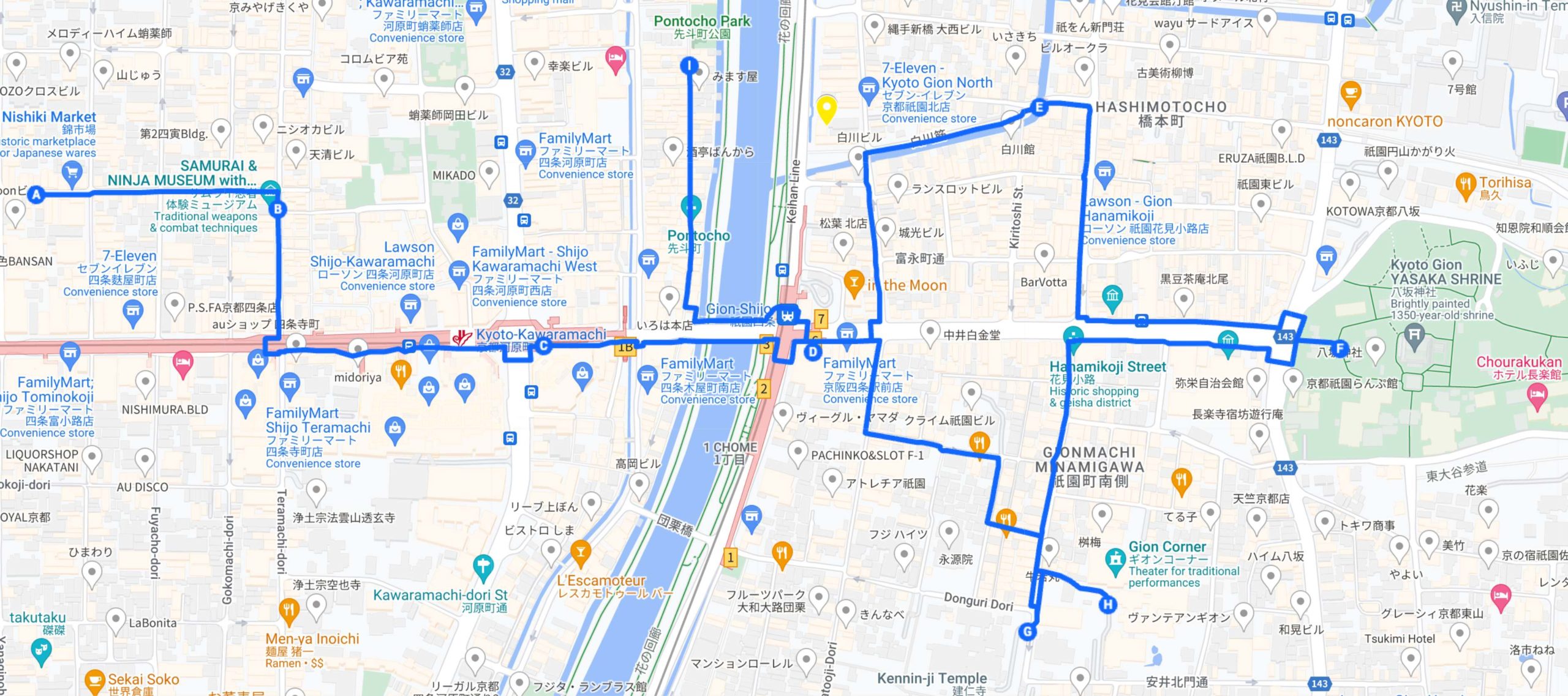
③ Gion Route
The Gion area is a treasure trove of entertainment. Theaters and museums where you can experience Japanese culture and history are concentrated within walking distance. Samurai, kabuki, maiko, and much more.
A. Nishiki Market
Nishiki Market is a historic market located in the heart of Kyoto. While there are no official records, it is believed that a market has existed in this area since the Heian period, roughly 1000 years ago.
The reason it’s speculated that a market stood here during the Heian period is largely due to the area’s access to high-quality groundwater. This cold groundwater is suitable for preserving fish and poultry. Additionally, its location in a populous central area and its convenience for deliveries to the Imperial Palace are also considered factors in the market’s development.The market offers a wide variety of fresh seafood, unique Kyoto ingredients, locally cultivated Kyoto vegetables, quality meats, and dried goods.
When it comes to Kyoto’s food culture, pickles stand out. The popularity of pickles can be attributed to both the geographical and cultural background of the region, as well as the influence of religion.
- Geographical Background:
While Kyoto has limited access to seafood, its abundant groundwater has fostered a diverse range of vegetables and a culture of innovative preservation methods. Mackerel from the Wakasa Bay in northern Kyoto was transported to the
city via a route known as the “Mackerel Highway”. The need to preserve seafood during transport led to the development of fermentation techniques, which were also used for preserving vegetables. Kyoto, surrounded by mountains and
characterized by cold winters and hot summers, seems to have been conducive to the fermentation of pickles.
2 Cultural Background:
Kyoto, being the long-standing center of the imperial court and aristocratic culture, developed a unique commoner culture. The people of Kyoto have, for generations, valued simplicity in life, leading to the creation of various pickles.
3 Influence of Zen Buddhism:
Around the 13th century, Zen Buddhism, a sect of Buddhism that originated in China, became widely practiced in Kyoto. Emphasizing simplicity, naturalness, and harmony, Zen Buddhism significantly influenced various aspects of Japanese
aesthetics and arts, including tea ceremonies, landscape paintings, architecture, Japanese cuisine, calligraphy, ink paintings, and flower arrangements.
Zen Buddhism, which values simplicity, led to the popularity of Shojin Ryori (Buddhist vegetarian cuisine). This cuisine, based on Buddhist teachings, avoids indulgence and meat consumption and is considered a form of spiritual discipline. Kyoto, being Japan’s ancient capital with many temples, has a deep-rooted tradition of Shojin Ryori. In recent years, this cuisine, which uses seasonal ingredients and is considered healthy, has gained attention from both young people and foreigners as a traditional Japanese food culture.
Kyoto vegetables, primarily cultivated and improved upon in the Kyoto region over the years, refer to a group of vegetable varieties that have been traditionally produced. These vegetables are especially used as essential ingredients in Kyoto’s traditional Japanese cuisine, “Kyo-ryori”. They also have strong ties with the tea ceremony’s Kaiseki cuisine and temple Shojin Ryori.
With the development of road networks, fresh fish can now be purchased at Nishiki Market.
Kyoto is renowned as the birthplace of white miso. The history of white miso dates back to the Heian period’s court culture. At that time, white miso, made with an abundance of valuable rice, was especially treasured among the aristocracy.
In Kyoto, the local dish known as “White Miso Zoni” made with white miso is particularly famous. This is a traditional dish eaten during the New Year in Kyoto Prefecture, consisting of a soup based on white miso with vegetables, chicken, and fish dumplings. This dish, often enjoyed with family during the cold winter season, symbolizes family bonds and longevity and is consumed on special occasions.
This food stall village is lined with stalls offering various Japanese seafood dishes, including fresh sashimi, oysters, seafood bowls, and black-haired Wagyu steak. Notably, the first glass of sake is offered for 100 yen, allowing visitors to enjoy it casually.
Chestnuts harvested in the Tanba region of Kyoto are very famous as “Tanba chestnuts,” renowned for their size and sweetness. The characteristics of the Tanba chestnuts are attributed to Kyoto’s basin-like geography, which results in significant temperature differences between day and night, and the fertile soil enriched by various rivers, creating ideal conditions that enhance the sweetness of the chestnuts.
Historically, chestnuts from Kyoto were used as offerings to the imperial court and the shogunate, and as sweets for tea ceremonies as the culture of tea spread. Chestnut rice is one of Kyoto’s essential local dishes.
Pike conger (Hamo) is very famous in Kyoto. The early summer coincides with the rainy season, and during this period, the pike conger enters its spawning season. Pike conger, nourished by the nutrient-rich rainwater, becomes fatty and reaches its peak season. The best time to enjoy pike conger is from July to August, just before spawning.
B. Nishiki Tenmangu
Exiting the Nishiki Market to the east, you’ll find the Nishiki Tenmangu Shrine. You’ll notice a large stone torii gate between the buildings. This gate, built in 1935, had a design flaw where the width of the approach was determined only by the position of the pillars, without considering the ends of the torii. As a result, buildings were constructed on both sides based on this flawed design, causing parts of the buildings to protrude into the torii.
“Nishiki Tenmangu” is associated with the former residence of Sugawara no Michizane’s father, known as the god of learning. After Sugawara no Michizane passed away in 903, the former residence became known as the Kanki-ji temple, and in 1003, it began to enshrine Japanese deities.In 1587, as part of the urban redevelopment plan by the famous Toyotomi Hideyoshi, who transformed Kyoto, the shrine was relocated to its current location. After many transitions, it stands today as the Nishiki Tenmangu Shrine.
Nishiki Tenmangu’s deity is Sugawara no Michizane, the god of learning, making the shrine popular for academic success and exam wishes.
There’s a wooden object made from the “Taigan Ume” tree. Inside this object, you can place a wish paper, seal it with a wooden plug, and hang it on the “Taigan Ume tree” within the shrine grounds. These offerings are burned during the monthly festival.
This cow, dedicated as a symbol of diligence, compassion, and health, is affectionately known to visitors as the “stroking cow.” Its head shines brightly from being frequently touched.
This cow, dedicated as a symbol of diligence, compassion, and health, is affectionately known to visitors as the “stroking cow.” Its head shines brightly from being frequently touched.
C. SAMURAI & NINJA MUSEUM
Ryoanji’s stone garden is also famous as a “Karesansui” garden. Stones represent islands, and lines drawn in the white sand depict the flow of water. There is also a miniature.
A profound feature is the water basin used for purification before entering the tea room. The phrase “吾唯足知” is inscribed on it. All four characters contain “口”, and the center of the basin, filled with water, represents the “口” to be part of each kanji character.
This phrase means “I only know contentment”. It suggests that those who know contentment are happy even in poverty, while those who don’t, even if wealthy, are unhappy. This embodies the Zen teaching that one should be content and grateful for what they have.
Surprisingly, “吾唯足知” is the name of a shochu brand produced by Hamada Shuzo in Kagoshima Prefecture.
Teramachi St.
Currently, Teramachi Street and its neighboring Shinkyogoku Street are bustling tourist streets, lively with local youth, school trip students, and foreign tourists.With fashion, general goods, cafes, and more, there are approximately 170 shops lined up.
From 1467, for about 11 years, the central part of Kyoto was devastated due to a power struggle known as the Onin War. After this war, around 1590, Japan entered the Warring States period, where wars took place throughout the country with the aim of unifying Japan under one ruler. One of the most famous warlords of this era, Toyotomi Hideyoshi, sought to unify Japan once again. Hideyoshi immediately undertook urban reconstruction to restore the devastated Kyoto. He gathered temples in this area and renamed the street “Teramachi Street,” creating a grand temple district. The word “寺” translates to “temple” and “町” to “town,” so Teramachi essentially means “temple town.” Originally, around the 12th century, this area was a high-end residential district with mansions of nobles. However, due to Hideyoshi’s policy, about 80 temples from various sects were systematically arranged here. One theory suggests that Hideyoshi lined up the temples on the eastern side of the city to serve as a shield against potential attacks from the east. The aim was to make it difficult for invaders to advance into the city by having to destroy a row of temples first. Nishiki Tenmangu Shrine existed as one of the temples that formed Teramachi.
Prosperity of Teramachi
During the Edo period, from the 17th to the 19th century, merchants dealing in books, rosaries, booklets, brushes, medicines, and craftsmen specializing in paper and shamisen, among other things, gathered and lived along this street,
forming the prototype of modern shopping streets. The final point of the “Tokaido Fifty-Three stages along the Tokaido Road” a major artery connecting the then-capital (modern-day Tokyo) and Kyoto, was also at “Teramachi Sanjo.”
Teramachi in Kyoto was renowned nationwide. However, the landscape began to change from the mid-19th century. Teramachi Street, being in the heart of Kyoto, saw many temples destroyed during the upheavals aimed at overthrowing the
Edo shogunate. Furthermore, with the establishment of the Meiji government, when the parallel-running Shinkyogoku Street was developed, the Kyoto Prefectural Government reduced the temple grounds and decreased the number of temples.
Nevertheless, from the 1900s onwards, Teramachi Street has always been an attractive Kyoto street, blending the old with the new. As Western culture began to permeate Japan, modern and trendy shops emerged, including Western confectioneries
and photo studios.
D. Kawaramachi St.
Kawaramachi Street is a bustling shopping area well-known in Kyoto. This street is home to numerous department stores, shopping streets, and drugstores, offering a one-stop shopping experience.
Interestingly, 800 years ago, the eastern side of Kawaramachi Street was an actual riverbank (“kawara” means riverbank). At that time, the Kamo River was about 200 meters wider than its current width. In the early 17th century, the Takase River was excavated in Osaka for transporting goods by water. Subsequently, to facilitate trade, embankments were built on the eastern side of Takasegawa Wood Town in 1670. The area between Takasegawa and Kamogawa was filled in, stone walls were constructed, and townhouses were formed, adding new urban functions to the present-day Kawaramachi Street and the area between it and the Kamo River.
In the early 17th century, Kyoto witnessed extensive new land developments, with 31 locations developed by 1733. In 1674, places like Higashi Kawara Shin-Yashiki and Sotomachi were developed as new districts.
Further to the east of Kawaramachi Street, the Kamo River flows from north to south. During spring and summer, riverbed dining platforms known as “kawadoko” are temporarily used. Kawadoko, which are elevated dining areas on the west side of the Kamo River, offer a popular spot for tourists to enjoy the view of the river during the summer.
The history of Kawadoko dates back to the era of Toyotomi Hideyoshi. Initially, Hideyoshi ordered the reconstruction of bridges like Sanjo and Gojo to secure the approach to the Hoko-ji Temple for worshippers and ensure sturdy bridges to withstand disasters. This led to increased activity on the riverbank of the Kamo River, attracting wealthy merchants who set up viewing seats and tea shops, marking the beginning of Kawadoko. During the Edo period, stone walls and embankments were developed, and entertainment districts and pleasure quarters formed, turning it into a lively entertainment area.
At its peak, Kawadoko existed not only at its current location. In the late 19th century, there were dining platforms on both the right and left banks of the Kamo River. Both banks featured raised dining platforms, and under the Sanjo Bridge, there were dining platforms extending from the riverbank. However, due to developments like the excavation of the Kamo River canal in 1894 and the extension of the railway in 1915, these dining platforms gradually disappeared, leading to the present-day appearance.
E. Minamiza
As you proceed through the spacious temple grounds, you’ll come across the Chūmon gate, which houses statues of Tamonten and Jikokuten, two of the Four Heavenly Kings in Japanese Buddhism. These kings serve as protectors of Buddhism, with Tamonten guarding the north and Jikokuten the east.
The Minami-za in Kyoto, the birthplace of Kabuki, was established along the Kamo River in Shijo Kawaramachi during the Edo period. It is a theater where traditional Japanese performing arts, mainly Kabuki, are performed.
Famous animes that Japan takes pride in, such as NARUTO and One Piece, have also been adapted into Kabuki and have been performed at Minami-za in the past. Incorporating wire action, with performers soaring above the audience, presents a new way to enjoy Kabuki at Minami-za that was unimaginable during the Edo period.
For beginners, it is recommended to use an earphone guide when watching Kabuki. As the stage progresses, the guide provides detailed explanations about the content, highlights, significance of costumes and props.
Rather than being in a formal educational style, it is reputed to be very easy to listen to and interesting.During intermission, interviews with actors and detailed explanations of the performance are also broadcasted, providing a wealth of information.Kabuki is not just for Japanese tourists; recently, foreigners have also been enjoying this theatrical art.
There’s an English earphone guide available that provides audio explanations for the plot, lines, songs, etc., allowing foreign tourists to enjoy it as well.For more details on Kabuki, click here. For more details on Kabuki, click here.
Gion Yamatooji St.
Although it declined during the Ōnin War, the temple was restored between 1624-1644 by the third shogun, Tokugawa Iemitsu. Buildings from the Kyoto Imperial Palace, including the Shishinden and Seiryōden, were relocated to become the main hall and Mieidō. The temple’s high prestige, stemming from its imperial foundation, made this relocation possible.
The main hall is where the temple’s principal deity and other important Buddhist statues are enshrined, serving as the focal point of devotion.
The main hall is where the temple’s principal deity and other important Buddhist statues are enshrined, serving as the focal point of devotion.
The main hall is where the temple’s principal deity and other important Buddhist statues are enshrined, serving as the focal point of devotion.
The sutra repository of Ryoan-ji is used to store Buddhist scriptures and important documents. It’s specially designed to maintain a constant temperature and humidity, protecting the contents from fire and pests.
Ryoan-ji Kyusho Myojin consists of three buildings: the main hall, left hall, and right hall, enshrining various deities.
Facing the main hall on the right is a five-storied pagoda, 36 meters tall, showcasing the Edo period architectural style where each tier has the same roof size.
Facing the main hall on the right is a five-storied pagoda, 36 meters tall, showcasing the Edo period architectural style where each tier has the same roof size.
This is the entrance to the palace, which houses the sleeping quarters, gardens, and other attractions. The Shishinden is a building associated with the emperor, used for hosting dignitaries and for ceremonies.
F. Shinbashi St.
This area was once known as the gateway town to Yasaka Shrine, lined with theaters and puppet theaters. During its peak from the late Edo period to the early Meiji period, many teahouses were said to have been established here. An area approximately 160 meters east-west and 100 meters north-south, centered around Shinbashi Street (indicated in red), has been designated as an Important Traditional Building Preservation District.
In the Gion Shinbashi district, about 70% of the buildings are traditional, two-story structures built shortly after the great fire of 1865 during the Edo period. These buildings, which are over 150 years old, feature lattice windows on the first floor and a second floor with a veranda that extends outward, adorned with “sudare” blinds.
The reason you often see geishas and maikos in this vicinity is that there are still many teahouses in operation. The roofs of Gion’s townhouses appear taller than those in other areas because they are built in the teahouse style. Teahouses primarily entertain guests on the second floor, which is why it’s taller than regular townhouses.
Kyoto Teahouse EntertainmentThe cost of inviting a maiko or geisha to a banquet is called “hana-dai.” In addition, there are separate charges for food and drinks. The cost varies depending on the teahouse and the status of the guests, so there’s no fixed price for the hana-dai.
The hospitality of the entertainment districts is not limited to the performances of geishas and maikos. It’s a unique culture where guests also participate in games like “Konpira Fune Fune” using a shamisen, “Tora Tora” which is a rock-paper-scissors game, and “Tosenkyo” using a fan.
Of course, while geishas and maikos are the stars of teahouse entertainment, the “okiya” that house and train them, the chefs who provide the banquet food, and the craftsmen who make the tools used by geishas and maikos all play crucial roles.
The teahouse system is remarkable for the role of the teahouse itself. They not only arrange for geishas and maikos but also coordinate everything from food and drink to room decor, hotel bookings, and taxi arrangements. The teahouse
operates on a deferred payment system, so guests don’t pay on the day they visit. This system ensures guests enjoy their experience without any hassle.
Guests settle their bills at a later date. This means that only individuals with a clear identity can be billed, hence the saying “no first-time guests allowed.” To visit a teahouse, one must first be introduced by a regular and
gain the trust of the teahouse’s proprietress. Only when deemed trustworthy can one visit the teahouse alone. Paradoxically, this practice ensures a higher level of hospitality by knowing the guests well.
Tatsumi DaimyojinThis small shrine is affectionately known as “Gion’s Inari.” It’s revered by Gion’s geishas, maikos, and even entertainers for its blessings in improving one’s artistic skills.
By the way, do you know the difference between “geisha” and “maiko”? Both are women who perform at banquets. “Maiko” refers to young girls training to become “geisha” and is unique to Kyoto. They must refine not only their artistic
skills but also their charm and conversational abilities.
Typically, girls start their training at 15 after graduating from middle school. They become maikos after an apprenticeship and then geishas after about five years. Geishas wear simple wigs and plain kimonos, while maikos style their
hair and wear colorful accessories.
Regarding footwear, geishas wear geta or zori sandals, while maikos wear tall geta sandals.
In terms of salary, geishas are self-employed, while maikos receive an allowance. Nowadays, due to compulsory education, girls wishing to become maikos enter the profession after middle school. They belong to “okiya,” similar to entertainment agencies. Some even attend middle school from their okiya. All expenses, including food, clothing, and training, are covered by the okiya. In return, they receive no salary until they become full-fledged geishas.
The history of maikos dates back about 300 years. It’s said to have started with waitresses working in teahouses, initially serving tea to visitors at shrines and temples. Over time, the service evolved from serving tea to performing songs and dances.
From here, let’s head south across Tatsumi Bridge towards Yasaka Shrine. This area, especially after crossing the bridge, exudes the unique ambiance of the Gion entertainment district. Crossing from Shinbashi Street, there’s a narrow alley called Gion Kiridoshi. This short 180-meter path is paved with cobblestones, exuding Gion’s elegance.
Looking at the townhouses on both sides of the street, you’ll notice protective barriers under the eaves. These can be seen in many townhouses throughout Kyoto and are called “Inuyarai.” Originally designed to prevent dogs from urinating on the walls, they also served to deter thieves and protect the walls from water splashed by passing carriages.
G. Yasaka Shrine
t the center of the Kimono Forest lies a power spot called “Dragon’s Atago Pond”. It is believed that immersing one’s hands in this pond brings happiness.
t the center of the Kimono Forest lies a power spot called “Dragon’s Atago Pond”. It is believed that immersing one’s hands in this pond brings happiness.
t the center of the Kimono Forest lies a power spot called “Dragon’s Atago Pond”. It is believed that immersing one’s hands in this pond brings happiness.
t the center of the Kimono Forest lies a power spot called “Dragon’s Atago Pond”. It is believed that immersing one’s hands in this pond brings happiness.
t the center of the Kimono Forest lies a power spot called “Dragon’s Atago Pond”. It is believed that immersing one’s hands in this pond brings happiness.
t the center of the Kimono Forest lies a power spot called “Dragon’s Atago Pond”. It is believed that immersing one’s hands in this pond brings happiness.
t the center of the Kimono Forest lies a power spot called “Dragon’s Atago Pond”. It is believed that immersing one’s hands in this pond brings happiness.
t the center of the Kimono Forest lies a power spot called “Dragon’s Atago Pond”. It is believed that immersing one’s hands in this pond brings happiness.
t the center of the Kimono Forest lies a power spot called “Dragon’s Atago Pond”. It is believed that immersing one’s hands in this pond brings happiness.
t the center of the Kimono Forest lies a power spot called “Dragon’s Atago Pond”. It is believed that immersing one’s hands in this pond brings happiness.
t the center of the Kimono Forest lies a power spot called “Dragon’s Atago Pond”. It is believed that immersing one’s hands in this pond brings happiness.
t the center of the Kimono Forest lies a power spot called “Dragon’s Atago Pond”. It is believed that immersing one’s hands in this pond brings happiness.
t the center of the Kimono Forest lies a power spot called “Dragon’s Atago Pond”. It is believed that immersing one’s hands in this pond brings happiness.
F. Shinbashi St.
t the center of the Kimono Forest lies a power spot called “Dragon’s Atago Pond”. It is believed that immersing one’s hands in this pond brings happiness.
t the center of the Kimono Forest lies a power spot called “Dragon’s Atago Pond”. It is believed that immersing one’s hands in this pond brings happiness.
t the center of the Kimono Forest lies a power spot called “Dragon’s Atago Pond”. It is believed that immersing one’s hands in this pond brings happiness.
t the center of the Kimono Forest lies a power spot called “Dragon’s Atago Pond”. It is believed that immersing one’s hands in this pond brings happiness.
t the center of the Kimono Forest lies a power spot called “Dragon’s Atago Pond”. It is believed that immersing one’s hands in this pond brings happiness.
t the center of the Kimono Forest lies a power spot called “Dragon’s Atago Pond”. It is believed that immersing one’s hands in this pond brings happiness.
t the center of the Kimono Forest lies a power spot called “Dragon’s Atago Pond”. It is believed that immersing one’s hands in this pond brings happiness.
t the center of the Kimono Forest lies a power spot called “Dragon’s Atago Pond”. It is believed that immersing one’s hands in this pond brings happiness.
G. Kenninji Temple
t the center of the Kimono Forest lies a power spot called “Dragon’s Atago Pond”. It is believed that immersing one’s hands in this pond brings happiness.
t the center of the Kimono Forest lies a power spot called “Dragon’s Atago Pond”. It is believed that immersing one’s hands in this pond brings happiness.
t the center of the Kimono Forest lies a power spot called “Dragon’s Atago Pond”. It is believed that immersing one’s hands in this pond brings happiness.
t the center of the Kimono Forest lies a power spot called “Dragon’s Atago Pond”. It is believed that immersing one’s hands in this pond brings happiness.
t the center of the Kimono Forest lies a power spot called “Dragon’s Atago Pond”. It is believed that immersing one’s hands in this pond brings happiness.
t the center of the Kimono Forest lies a power spot called “Dragon’s Atago Pond”. It is believed that immersing one’s hands in this pond brings happiness.
t the center of the Kimono Forest lies a power spot called “Dragon’s Atago Pond”. It is believed that immersing one’s hands in this pond brings happiness.
t the center of the Kimono Forest lies a power spot called “Dragon’s Atago Pond”. It is believed that immersing one’s hands in this pond brings happiness.
t the center of the Kimono Forest lies a power spot called “Dragon’s Atago Pond”. It is believed that immersing one’s hands in this pond brings happiness.
t the center of the Kimono Forest lies a power spot called “Dragon’s Atago Pond”. It is believed that immersing one’s hands in this pond brings happiness.
t the center of the Kimono Forest lies a power spot called “Dragon’s Atago Pond”. It is believed that immersing one’s hands in this pond brings happiness.
t the center of the Kimono Forest lies a power spot called “Dragon’s Atago Pond”. It is believed that immersing one’s hands in this pond brings happiness.
t the center of the Kimono Forest lies a power spot called “Dragon’s Atago Pond”. It is believed that immersing one’s hands in this pond brings happiness.
t the center of the Kimono Forest lies a power spot called “Dragon’s Atago Pond”. It is believed that immersing one’s hands in this pond brings happiness.
t the center of the Kimono Forest lies a power spot called “Dragon’s Atago Pond”. It is believed that immersing one’s hands in this pond brings happiness.
t the center of the Kimono Forest lies a power spot called “Dragon’s Atago Pond”. It is believed that immersing one’s hands in this pond brings happiness.
H. Gion Corner
t the center of the Kimono Forest lies a power spot called “Dragon’s Atago Pond”. It is believed that immersing one’s hands in this pond brings happiness.
t the center of the Kimono Forest lies a power spot called “Dragon’s Atago Pond”. It is believed that immersing one’s hands in this pond brings happiness.
Hanamikoji St.
t the center of the Kimono Forest lies a power spot called “Dragon’s Atago Pond”. It is believed that immersing one’s hands in this pond brings happiness.
t the center of the Kimono Forest lies a power spot called “Dragon’s Atago Pond”. It is believed that immersing one’s hands in this pond brings happiness.
t the center of the Kimono Forest lies a power spot called “Dragon’s Atago Pond”. It is believed that immersing one’s hands in this pond brings happiness.
t the center of the Kimono Forest lies a power spot called “Dragon’s Atago Pond”. It is believed that immersing one’s hands in this pond brings happiness.
t the center of the Kimono Forest lies a power spot called “Dragon’s Atago Pond”. It is believed that immersing one’s hands in this pond brings happiness.
t the center of the Kimono Forest lies a power spot called “Dragon’s Atago Pond”. It is believed that immersing one’s hands in this pond brings happiness.
I. Pontocho St.
t the center of the Kimono Forest lies a power spot called “Dragon’s Atago Pond”. It is believed that immersing one’s hands in this pond brings happiness.
t the center of the Kimono Forest lies a power spot called “Dragon’s Atago Pond”. It is believed that immersing one’s hands in this pond brings happiness.
t the center of the Kimono Forest lies a power spot called “Dragon’s Atago Pond”. It is believed that immersing one’s hands in this pond brings happiness.
t the center of the Kimono Forest lies a power spot called “Dragon’s Atago Pond”. It is believed that immersing one’s hands in this pond brings happiness.
t the center of the Kimono Forest lies a power spot called “Dragon’s Atago Pond”. It is believed that immersing one’s hands in this pond brings happiness.
t the center of the Kimono Forest lies a power spot called “Dragon’s Atago Pond”. It is believed that immersing one’s hands in this pond brings happiness.
t the center of the Kimono Forest lies a power spot called “Dragon’s Atago Pond”. It is believed that immersing one’s hands in this pond brings happiness.
t the center of the Kimono Forest lies a power spot called “Dragon’s Atago Pond”. It is believed that immersing one’s hands in this pond brings happiness.
t the center of the Kimono Forest lies a power spot called “Dragon’s Atago Pond”. It is believed that immersing one’s hands in this pond brings happiness.
t the center of the Kimono Forest lies a power spot called “Dragon’s Atago Pond”. It is believed that immersing one’s hands in this pond brings happiness.
月 日付 行事名 時間 場所 備考 毎月 4日 月並法要(阿弥陀堂) 11:00~ – – 毎月 18日 観音会(観音堂) 11:00~ – – 毎月 21日 御影供(御影堂) 9:30~ – – 毎月 25日 御室88護摩供(萬霊堂) 14:00~ – – 毎月 28日 護摩供(大黒堂) 10:00~ – – 1月 1日 修正会 – 金堂 一般参拝不可 1月 6日 御室流華道生初式 11:00~ 宸殿 – 1月 7日 初祈祷会 10:00~ 御影堂 – 2月
2日 節分会 9:30~ 金堂 – 2月 15日 常楽会 9:30~ 金堂 – 3月 1日 土砂加持法要 9:30~ 金堂 – 3月 20日 春季名宝展 – 霊宝館 3月20日~5月31日 3月 20日 御室花まつり – – 3月20日~5月9日 3月 21日 春季彼岸会 13:30~ 金堂 – 3月 24日 春季御室霊園水子地蔵尊供養会 13:00~ 御室霊園 – 4月 – 桜開花時期 御室花まつり – – 特別入山料 5月 12日, 13日 御室流華道流祖奉献全国挿花大会
– 御殿 – 6月 6日, 7日, 8日 授戒会 – – 一般参拝不可 6月 15日 宗祖誕生会 – – – 9月 8日 開山忌 10:00~ 御影堂 – 9月 23日 秋季名宝展 – 霊宝館 9月23日~12月3日 9月 21日 秋季彼岸会 13:30~ 金堂 – 9月 23日 秋季彼岸御室霊園供養会 10:00~ 金堂 – 10月 16日 福王寺神社大祭 15:00~ 仁和寺御所庭園 南庭 – 10月 27日 諡号奉賛法要 13:30~ 御影堂 – 12月
1日 伝法潅頂 – – 一般参拝不可