Hideyoshi related route
時間 1時間25分 Total 1hour 25min
Hideyoshi Toyotomi was a farmer by birth who rose through the ranks to serve Nobunaga Oda as a sandal-cutter. A sandal-cutter, in modern terms, is a person who carries the leader’s shoes with him at all times, and puts them out at his master’s feet when he goes outdoors. Hideyoshi became a vassal of Nobunaga at the age of 17, but his talent for doing things well was recognized, and he was tasked with fighitng in wars. Hideyoshi later succeeded Nobunaga, who died in the Honnoji Incident in 1582. Hideyoshi eventually unified the country by destroying the Hojo Clan in Odawara Castle in 1590. Please see
Hideyoshi in details before you go through this route.
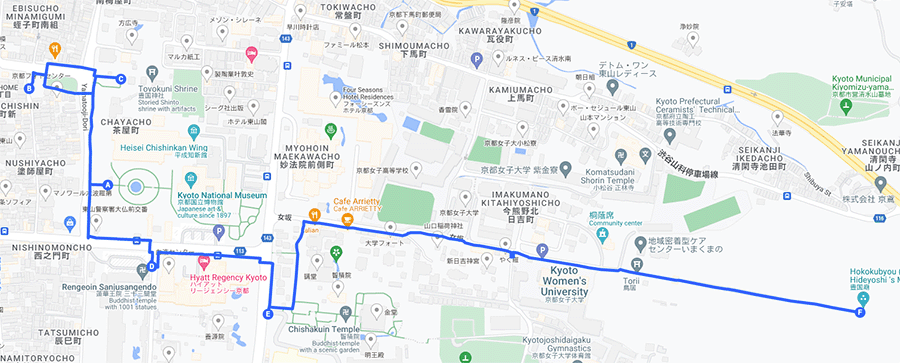
Before we walk around the sights, let’s learn a little more about Hideyoshi. In his prime, Hideyoshi not only lived a life of luxury and splendor, but also created many great achievements.
Juraku-dai
In 1587, Hideyoshi built what is now the lavishly decorated, gold-leafed Juraku-dai, and built a vast castle town around it. Surrounded by 1,800 meters of stone walls and moats, the castle even has a tower. If Juraku-dai, built by the flamboyant Hideyoshi, had remained, it would have been a famous tourist attraction, crowded with foreign visitors, but unfortunately, it is no longer there.
Around station
Tea Ceremony
Hideyoshi also held a large tea ceremony for 1,000 people at Kitano-Tenmangu Shrine to promote his authority. This was a major event that was rare in those days, where people drank tea and socialized regardless of their status. It could truly be called a national event. Hideyoshi called for people to bring only one tea bowl, and Sen no Rikyu was in charge of the overall direction of the event.
200YEN
Sen no Rikyu
Sen no Rikyu was a man of ingenuity in the use of tea utensils and tools, who strived to perfect the simplicity of Japanese tea by eliminating waste to the utmost limit. He was a professional tea master who served Hideyoshi, established himself as a tea master, and earned Hideyoshi’s trust more than anyone else. However, Sen no Rikyu incurred the wrath of Hideyoshi after this tea ceremony and was put to death.
200YEN
Footbath
Hideyoshi also held a large tea ceremony for 1,000 people at Kitano-Tenmangu Shrine to promote his authority. This was a major event that was rare in those days, where people drank tea and socialized regardless of their status. It could truly be called a national event. Hideyoshi called for people to bring only one tea bowl, and Sen no Rikyu was in charge of the overall direction of the event.
200YEN
Footbath
Hideyoshi implemented the sword hunt implemented in 1588 to prevent the frequent peasant uprisings that occurred during the Warring States period. Hideyoshi confiscated swords, spears, and other weapons from farmers to prevent armed uprisings, but the stated purpose of the sword hunt was to “collect iron as raw material for nails to be used in the construction of the Great Buddha at Hokoji Temple in Kyoto. At a time when most of the peasants believed in Buddhism, they believed that they would not be able to resist the sword hunt if it was to build the Great Buddha, an object of worship.
200YEN
Footbath
In 1590, he defeated the Hojo clan in a decisive battle at Odawara, located in the western part of present-day Kanagawa Prefecture, and finally achieved national unification. Thereafter, in 1592 and 1597, he attempted to invade Korea twice in order to expand his territory overseas, but without achieving any significant results. Hideyoshi died of illness in 1598, and his forces were forced to withdraw from Korea.
200YEN
Footbath
After Hideyoshi’s death, a power struggle ensued within the government. The decisive battle of Sekigahara took place in 1600 between Ishida Mitsunari, who was Hideyoshi’s subordinate, and Ieyasu Tokugawa. Ieyasu Tokugawa defeated Ishida Mitsunari, and three years later he became Seii Taishogun and established the Edo Shogunate, located in what is now Tokyo.
200YEN
Footbath
However, after Hideyoshi’s death, and Ieyasu claimed power, Hideyoshi’s son was still alive and well in Osaka, and the Imperial Court and the nobles still recognized the Toyotomi family as the representative of the samurai. Ieyasu believed that if the Toyotomi family was not destroyed, the Edo shogunate would never be at peace. Ieyasu imposed a variety of difficult problems on the Toyotomi family and searched for an opportunity to start a war. Then, an incident with the temple bell at Hokoji led to two wars and the destruction of the Toyotomi family.
200YEN
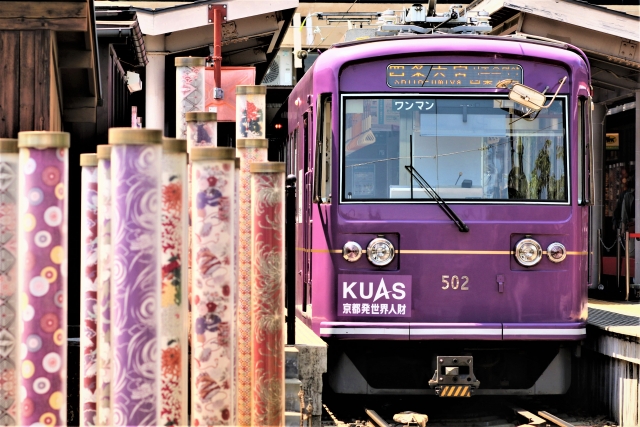
Kimono Forest
There are 600 poles about 2 meters high, wrapped in acrylic with kimono fabric. This fabric is made by an unique dyeing technique called kyo-yuzen.
Around station
Building
The main building of the museum is a brick building designed by Tokuma Katayama and completed in 1895 in the French Renaissance style. The museum exhibits mainly cultural properties of Kyoto from the Heian to Edo periods, and also conducts research on cultural properties. In addition to the regular exhibitions, special exhibitions are held two to four times a year. In addition to exhibits related to Hideyoshi, a wide range of other artifacts are on display, making it a must-see.
200YEN
Site of Houkouji Temple
In 1588, Hideyoshi, who was in the process of unifying the whole country, built Hokoji Temple in an attempt to create a giant Buddha that would rival Todaiji Temple in Nara. The huge building of Hokoji Temple does not remain today, but remnants of the stone wall can still be seen today. These stone walls now surround the Kyoto National Museum.
200YEN
Stone Wall
This stone wall was built by Hideyoshi, who was a flamboyant man, and its main feature is the use of huge rocks. It was Hideyoshi’s attempt to show the extent of his power in a visible way. However, excavations have shown that the stone walls are made of flat slabs of rock, and each rock has no depth. The rocks were piled up in a direction that made them look as large as possible.
200YEN
Incredible behavior
Also, there are stone Buddhas and stone pagodas that were massively packed behind this stone wall. When the museum was built, the items found behind the stone wall were laid out in the east garden of the museum. As part of the normal construction process, it is not uncommon from a civil engineering point of view to pack slightly smaller stones behind the stone walls. However, breaking down stone Buddhas and pagodas that are thought to have been built in the cemetery and stuffing them behind the stone walls is unthinkable from the Buddhist perspective of the time.
200YEN
So did Nobunaga
Incidentally, Hideyoshi’s old boss, Nobunaga Oda, was a die-hard rationalist and did the same thing. It is not that he was without any faith in God and Buddha, but he was skeptical of things that cannot be explained by logic, such as the afterlife and psychic spirits. In fact, gravestones and stone Buddhas were crushed and used as construction materials for the stone steps and stone walls of Azuchi Castle and the former Nijo Castle, which Nobunaga was involved in building. Such acts are shocking considering that at that time, people believed in hauntings and grudge-bearing spirits more than today.
200YEN
About
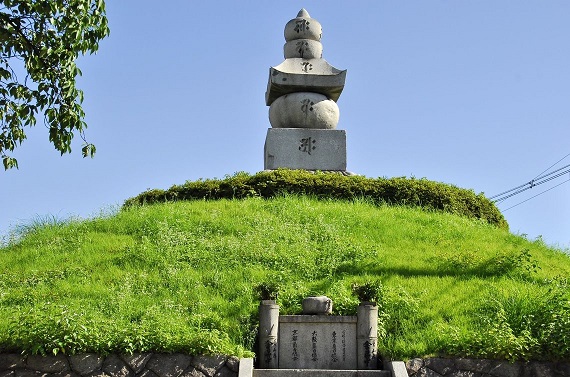
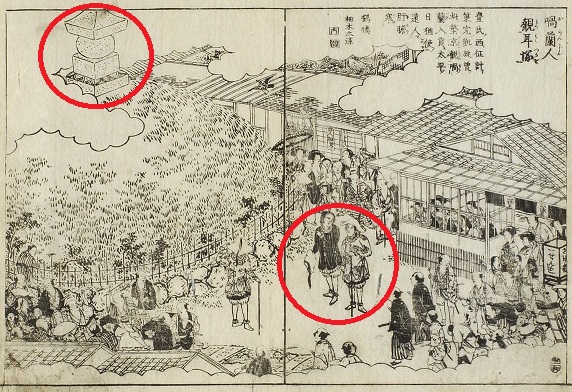
This is a memorial mound for those who died in at the hands of Hideyoshi Toyotomi, who united the country and invaded the Korean peninsula between 1592 and 1598 in an attempt to expand his territory into China. Instead of heads, which was a sign of victory, the noses and ears of the Korean soldiers were shaved, pickled in salt, and brought back to Japan, where they were buried here by order of Hideyoshi. It is said that the ears and noses of about 20,000 people are buried here.
Company Name
Famous for Foreiners
The reason for this is unknown, but it seems that this mound was a popular tourist attraction during the Edo period, and there was even a painting of a Dutchman looking at an ear mound.
Company Name
Famouse name on it
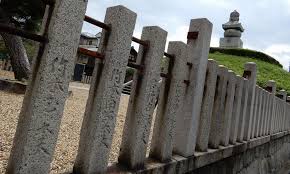
The stone fence that surrounds the mural has names engraved on it, which were donated by various top-notch entertainers to commemorate the 300th anniversary of the mural’s construction. The names of Kabuki actor Koshiro Matsumoto and others are engraved on the fence.
Company Name
Toyokuni Festival
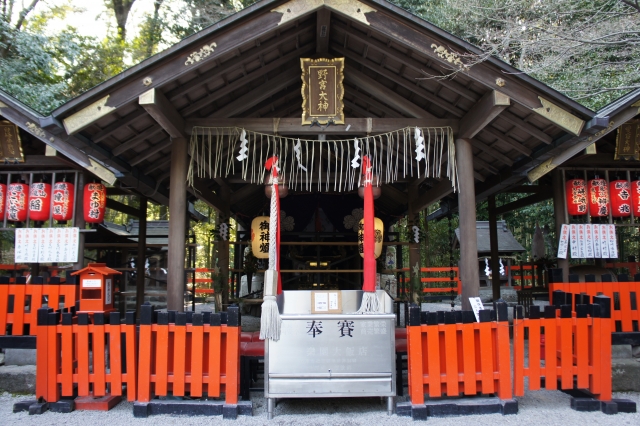
Toyokuni Shrine is a shrine dedicated to Hideyoshi. Every year in August, on the anniversary of Hideyoshi’s death, the Toyokuni Festival was held with great fanfare, and many people are said to have attended.

Company Name
Temple Bell of Houhouji Temple
Next to Toyokuni Shrine is the hanging bell of Hokoji Temple. The huge building of Hokoji Temple is no longer in existence, but the hanging bell that triggered Ieyasu Tokugawa’s downfall of the Toyotomi family is still in place.
Company Name
Toyokuni Festival
Toyokuni Shrine is a shrine dedicated to Hideyoshi. Every year in August, on the anniversary of Hideyoshi’s death, the Toyokuni Festival was held with great fanfare, and many people are said to have attended.
Company Name
Temple Bell of Houhouji Temple
Next to Toyokuni Shrine is the hanging bell of Hokoji Temple. The huge building of Hokoji Temple is no longer in existence, but the hanging bell that triggered Ieyasu Tokugawa’s downfall of the Toyotomi family is still in place.
Company Name
Yasaka Shrine was built in 656. A town developed around the entry gate to serve the many worshippers that came to the shrine. It eventually developed into the Geisha district of Gion.
The meaning of 33
The number 33 in Sanjusangendo refers to the fact that there are 33 pillars in the inner sanctum of the temple. It is said that the number 33 is the same as the 33 sacred places in the western part of Japan and the 33 sacred places in the western part of Omi, and comes from the belief that Kannon appears in 33 different forms to save people who are seeking help.
Company Name
Thousand-armed Goddess
The 1,001 statues of the thousand-armed Goddess of Mercy lined up in an orderly fashion on the 10-tiered platform are a sight to behold, and they are said to save everyone with their countless hands. When you enter the hall of Sanjusangendo, you will find a surprisingly large space. In the center of the hall is a large seated statue of the thousand-armed Goddess of Mercy, flanked on either side by 500 more standing statues of the eleven-faced thousand-armed Goddess of Mercy.
Company Name
Space in front of Shrine
You may have noticed that the intersection in front of Yasaka Shrine is quite large. Higashioji Street, stretching from this intersection to the north and south, and Shijo Street, stretching to the west, were not so wide in the past. These are the traces of the streetcars that were laid down in 1912, before World War I, when Kyoto City greatly widened Higashioji-dori and Shijo-dori streets.
Company Name
Fujin and Raijin
Also a must-see are the Fujin and Raijin (gods of wind and thunder) which are designated as national treasures. They are placed on the left and right sides of the hall. The wind and thunder gods are raging demon gods who control the weather, such as typhoons and lightning strikes, and bring misfortune to people. Since they are originally deified natural phenomena, they have the power to protect people from natural disasters.
Company Name
long-range archery
And this Sanjusangendo was the stage for “Tsushinya” in the Edo period. The name “Tsushinya” comes from the fact that an arrow is shot under the eaves of the hall. The target was placed at the north end of the hall, and bows were shot through a distance of 120 meters from the south end of the hall to see who could hit the target. This was an archery sport of olden days. Even today, the “Sanjusangendo Large Target National Tournament” is still held, and the competition consists of setting up an archery range of about 60 meters on the west side of the main hall and shooting a target with a diameter of one meter.
Company Name
Okame-ishi
(turtle stone)
This is the head temple of the Chizan sect of Shingon Buddhism. Chizakuin has a history starting with the conflict between Hideyoshi Toyotomi and Ieyasu Tokugawa. Chisakuin was initially located on a mountain in Wakayama Prefecture, far away from Kyoto. At that time, the Buddhist forces of Chisakuin were at odds with Hideyoshi, and in 1585, Hideyoshi burned down the entire mountain.
Company Name
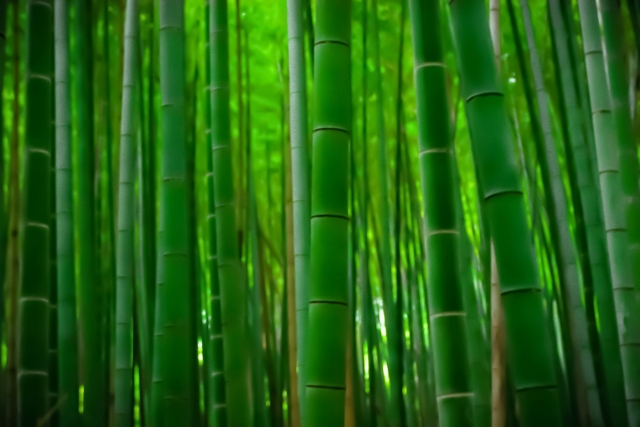
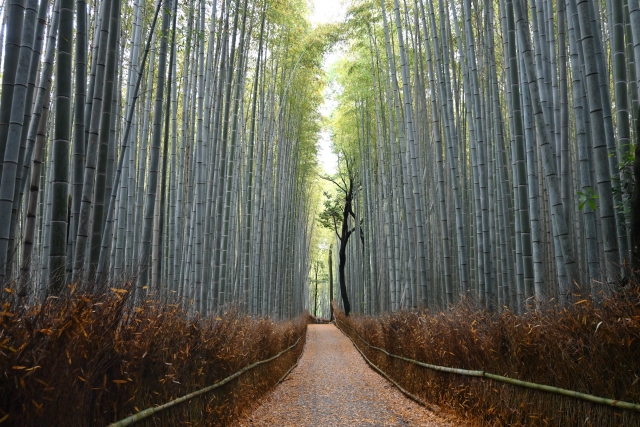
Season of beautiful bamboos
In this place where Chishakuin is now located, there was originally a temple called Shoun Zenji built by Hideyoshi. Hideyoshi was unable to have children, but at the age of 53, he finally had a child named Tsurumatsu. However, Tsurumatsu passed away at the young age of three, so he built Shounzenji Temple to pray for his soul. In 1615, however, Ieyasu Tokugawa destroyed the Toyotomi family, and the times changed dramatically. Ironically, Ieyasu donated the temple to Chishakuin, and Chishakuin went on to rebuild itself.
Company Name
Masterpiece
At Chisaki-in Temple, there are still gold and green barrier paintings by Tohaku Hasegawa and others that were painted under Hideyoshi and are representative of the Momoyama period. Even though the paintings are more than 400 years old, the colors are brighter and more powerful than you would expect, and the cherry blossoms are bold and symbolic of Hideyoshi’s power.
Company Name
A place to learn
In the Edo period (1603-1868), Chisakuin was famous as a temple of learning, where not only religion but astronomy and geology could also be studied. It seems to have been a very open and generous temple, as monks of other sects and ordinary people could also study there.
Company Name
To visit the Toyokuni Mausoleum, you have to climb up more than 500 steps, so if you are a traveler with time to spare, it is a good idea to go there.
Hideyoshi’s tomb
This is the tomb of Hideyoshi Toyotomi, who was victorious in the Warring States Period and unified the country in 1598. The tomb of Hideyoshi, who died at the age of 62 at Fushimi Castle in Kyoto, is located about 3 kilometers east of JR Kyoto Station. However, in 1615, Toyokuni’s mausoleum was destroyed by order of Ieyasu Tokugawa, and the tomb was left exposed to the elements, and with no one to visit it.
Company Name
Hideyoshi’s Mummy
A long time later, the Meiji government rebuilt Toyokuni Shrine in 1897, on the the 300th anniversary of the death of Hideyoshi. It was at this time that the remains of Hideyoshi were discovered in an unusual way. In a crude urn about one meter in diameter, there was the mummified body of Hideyoshi, sitting with his arms and legs crossed, facing west, the direction of the Kyoto Imperial Palace.
Company Name
Other temples and places related to Hideyoshi are also introduced here. Please refer to the respective links.
Nishi Honganji Temple
Nishi Honganji Temple was built in 1591 by a monk named Kennyo with land donated by Hideyoshi.
Company Name
eeeee
sentences
Company Name