②Famous Temple & Theme Park
時間 1時間25分 Total 1hour 25min
Kinkakuji, Ryoanji, and Ninna-ji are three renowned temples registered as “World Heritage Sites,” making them a golden route for sightseeing in Kyoto’s temples and shrines. Lastly, there’s the Toei Uzumasa Eigamura, an experiential theme park where visitors can enjoy attractions such as ninja experiences and transformation experiences, as well as events featuring Movie animation characters. For each temple, you’d want to allocate between 30 minutes to 1 hour, and for Toei Uzumasa Eigamura (Toei Kyoto Studio Park), it’s recommended to set aside at least 2 hours.
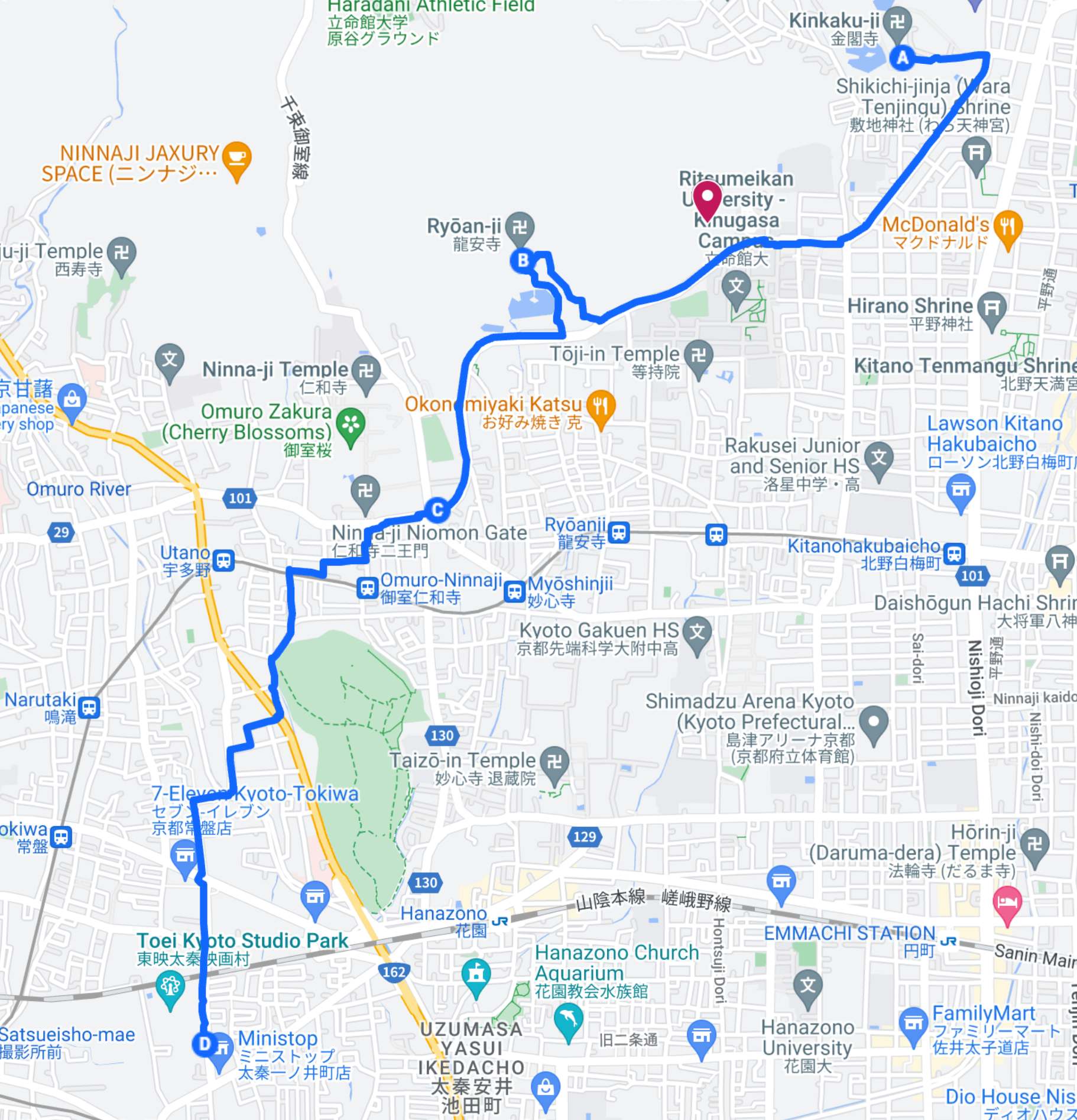
A. Kinkakuji Temple
Kinkaku-ji is a temple of the Rinzai Shū Sōkoku-ji Sect and has existed for over 600 years. Back then, it was a mansion and garden of the Saionji family, a noble family.
Ashikaga Yoshimitsu, the third shogun of the Muromachi shogunate, acquired it and constructed the Kitayama-den villa in 1397.
As Yoshimitsu, the most powerful figure of his time, conducted political affairs here, it became the political center for about 10 years until his death.
Among the buildings, the Golden Pavilion was constructed as a Shariden.
A Shariden is a building where the relics of Buddha, known as “Buddha’s ashes,” are enshrined. Buddha, the founder of Buddhism, was a prince born about 2,500 years ago.
He was a prince of the Shakya clan in southwestern Nepal, which is why he was called “Shaka” or “Buddha.” After attaining enlightenment, his teachings spread throughout Asia as Buddhism.
However, in Japan, there are generally over 200 facilities enshrining Buddha’s relics. The relics or hairs of Buddha that are enshrined are often symbolized and venerated as gemstones like agate or jade.
Kinkaku-ji is not just luxurious; it was built with a significant intention. The lowest floor is built in the Shinden style, the middle floor in the Samurai style, and the top floor in the Chinese-style Zen Buddhist temple style.
The Shinden style of the lowest floor symbolizes the residences of the imperial family and nobility that flourished during the Heian period (8-12C A.D.), while the Samurai style of the middle floor symbolizes the residences of the warriors who rose to power from the Kamakura period (12-14C A.D.).
Above these layers representing the imperial and warrior classes, Yoshimitsu, who was deeply influenced by Zen Buddhism, established a Zen room.
Also, on the roof, there is a statue of the phoenix, a legendary creature from China that appears with a righteous emperor.
B. Ryoanji Temple
In 1975, Queen Elizabeth II of the United Kingdom visited the stone garden of Ryoanji Temple, making it world-famous.
The aspect ratio of Ryoanji’s stone garden is the golden ratio (1:1.618), considered the most beautiful ratio. The walls surrounding the stone garden are inclined so that the rear side is higher, creating a sense of depth and spaciousness.
In 1994, the stone garden and the entire precinct of Ryoanji were registered as a World Heritage Site under “Historic Monuments of Ancient Kyoto”. The simple design, with 15 stones of various sizes placed in white sand, invites visitors to a Zen state of mind.
Although there are 15 stones in total, from any angle, only 14 stones are visible. This interesting arrangement represents imperfection, as 15 is a number symbolizing perfection in the Eastern world.
Ryoanji’s stone garden is also famous as a “Karesansui” garden. Stones represent islands, and lines drawn in the white sand depict the flow of water. There is also a miniature.
A profound feature is the water basin used for purification before entering the tea room. The phrase “吾唯足知” is inscribed on it. All four characters contain “口”, and the center of the basin, filled with water, represents the “口” to be part of each kanji character.
This phrase means “I only know contentment”. It suggests that those who know contentment are happy even in poverty, while those who don’t, even if wealthy, are unhappy. This embodies the Zen teaching that one should be content and grateful for what they have.
Surprisingly, “吾唯足知” is the name of a shochu brand produced by Hamada Shuzo in Kagoshima Prefecture.
From May to June, the water lilies in the Kyoyo Pond bloom beautifully.
C. Ninna-ji Temple
In 888, Emperor Uda founded the temple, inheriting the will of his father, Emperor Kōtoku, who passed away the previous year. Being a temple established by an emperor, it holds high prestige, and structures like the main hall reflect the royal court culture.
As you proceed through the spacious temple grounds, you’ll come across the Chūmon gate, which houses statues of Tamonten and Jikokuten, two of the Four Heavenly Kings in Japanese Buddhism. These kings serve as protectors of Buddhism, with Tamonten guarding the north and Jikokuten the east.
Beyond the Chūmon gate, on the left, is the late-blooming cherry tree known as “Omuro Sakura.” Designated as a national scenic spot, its blossoms emerge in mid-April, offering a second cherry blossom viewing opportunity just as the city’s other cherry blossoms begin to fall.
The Kannon Hall houses the principal deity, the Thousand-Armed Kannon, along with 28 other statues and wall paintings that retain their colors from about 370 years ago. While it’s not usually open to the public, it was specially opened in 2019 after six years of conservation work.
The Mieidō is known as a place used for specific rituals and ceremonies, especially the ceremony honoring Kōbō Daishi Kūkai, known as “Kōbō Daishi Mieikyō.”
The bell tower houses a bell, rung at specific times or during ceremonies, serving to announce the time or call out to the faithful.
Although it declined during the Ōnin War, the temple was restored between 1624-1644 by the third shogun, Tokugawa Iemitsu. Buildings from the Kyoto Imperial Palace, including the Shishinden and Seiryōden, were relocated to become the main hall and Mieidō. The temple’s high prestige, stemming from its imperial foundation, made this relocation possible.
The main hall is where the temple’s principal deity and other important Buddhist statues are enshrined, serving as the focal point of devotion.
The sutra repository of Ryoan-ji is used to store Buddhist scriptures and important documents. It’s specially designed to maintain a constant temperature and humidity, protecting the contents from fire and pests.
Ryoan-ji Kyusho Myojin consists of three buildings: the main hall, left hall, and right hall, enshrining various deities.
Facing the main hall on the right is a five-storied pagoda, 36 meters tall, showcasing the Edo period architectural style where each tier has the same roof size.
This is the entrance to the palace, which houses the sleeping quarters, gardens, and other attractions. The Shishinden is a building associated with the emperor, used for hosting dignitaries and for ceremonies.
Ryoan-ji’s gardens comprise the South Garden and North Garden. The sand in the South Garden is always meticulously maintained, while the view from the North Garden harmoniously blends the blue sky, fresh greenery, and architecture.
D. Toei Kyoto Studio Park
t the center of the Kimono Forest lies a power spot called “Dragon’s Atago Pond”. It is believed that immersing one’s hands in this pond brings happiness.
t the center of the Kimono Forest lies a power spot called “Dragon’s Atago Pond”. It is believed that immersing one’s hands in this pond brings happiness.
t the center of the Kimono Forest lies a power spot called “Dragon’s Atago Pond”. It is believed that immersing one’s hands in this pond brings happiness.
t the center of the Kimono Forest lies a power spot called “Dragon’s Atago Pond”. It is believed that immersing one’s hands in this pond brings happiness.
t the center of the Kimono Forest lies a power spot called “Dragon’s Atago Pond”. It is believed that immersing one’s hands in this pond brings happiness.
t the center of the Kimono Forest lies a power spot called “Dragon’s Atago Pond”. It is believed that immersing one’s hands in this pond brings happiness.
t the center of the Kimono Forest lies a power spot called “Dragon’s Atago Pond”. It is believed that immersing one’s hands in this pond brings happiness.
t the center of the Kimono Forest lies a power spot called “Dragon’s Atago Pond”. It is believed that immersing one’s hands in this pond brings happiness.
t the center of the Kimono Forest lies a power spot called “Dragon’s Atago Pond”. It is believed that immersing one’s hands in this pond brings happiness.
月 日付 行事名 時間 場所 備考 毎月 4日 月並法要(阿弥陀堂) 11:00~ – – 毎月 18日 観音会(観音堂) 11:00~ – – 毎月 21日 御影供(御影堂) 9:30~ – – 毎月 25日 御室88護摩供(萬霊堂) 14:00~ – – 毎月 28日 護摩供(大黒堂) 10:00~ – – 1月 1日 修正会 – 金堂 一般参拝不可 1月 6日 御室流華道生初式 11:00~ 宸殿 – 1月 7日 初祈祷会 10:00~ 御影堂 – 2月
2日 節分会 9:30~ 金堂 – 2月 15日 常楽会 9:30~ 金堂 – 3月 1日 土砂加持法要 9:30~ 金堂 – 3月 20日 春季名宝展 – 霊宝館 3月20日~5月31日 3月 20日 御室花まつり – – 3月20日~5月9日 3月 21日 春季彼岸会 13:30~ 金堂 – 3月 24日 春季御室霊園水子地蔵尊供養会 13:00~ 御室霊園 – 4月 – 桜開花時期 御室花まつり – – 特別入山料 5月 12日, 13日 御室流華道流祖奉献全国挿花大会
– 御殿 – 6月 6日, 7日, 8日 授戒会 – – 一般参拝不可 6月 15日 宗祖誕生会 – – – 9月 8日 開山忌 10:00~ 御影堂 – 9月 23日 秋季名宝展 – 霊宝館 9月23日~12月3日 9月 21日 秋季彼岸会 13:30~ 金堂 – 9月 23日 秋季彼岸御室霊園供養会 10:00~ 金堂 – 10月 16日 福王寺神社大祭 15:00~ 仁和寺御所庭園 南庭 – 10月 27日 諡号奉賛法要 13:30~ 御影堂 – 12月
1日 伝法潅頂 – – 一般参拝不可