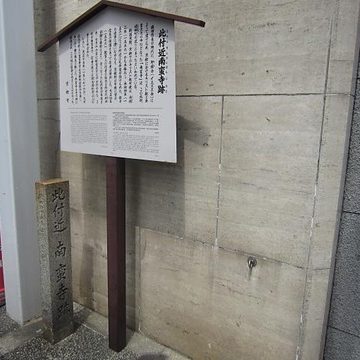
Nanbanji ruins
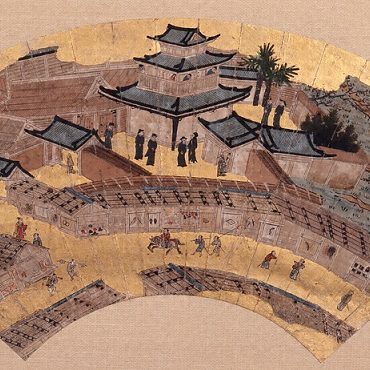
The figure below shows a map of Nanbanji, on display at the Kobe City Museum. It was the first Christian place of worship in Kyoto. Built in 1561, it was a three-story cathedral built by the Jesuits as base for missionaries in Kyoto, with the understanding of Nobunaga. The church was devastated, but rebuilt in 1576, and became a popular landmark in Kyoto. The surrounding area became known as ‘Daiusu Town’ after Deus, which means God. Records state that hundreds of Christians held mass at this location.
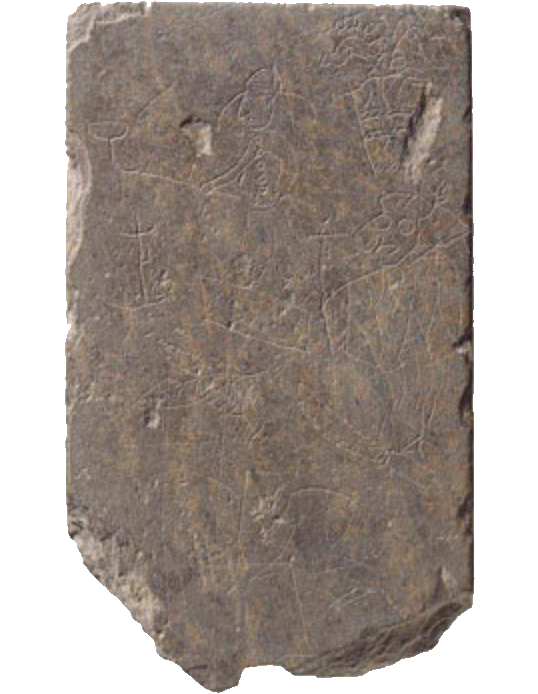
In 1973, a research team from Doshisha University conducted an excavation survey and discovered the foundation stone and inkstone.
The inkstone was painted in the 16th century, and is thought to depict a ritual such as mass; it is unlikely that ordinary Japanese people in the 16th century would have worn clothes with buttons, and these are thought to be Westerners. The two figures in the painting have large noses, emphasizing their Western features.
The lower right figure is a priest wearing a mitre and holding a staff in his hand.
The figure in the upper center is thought to be an attendant wearing a cap with a brim and a garment with buttons on the chest. The attendant is holding a long candlestick, a cross and a vessel apparently containing wine.
The cornerstone is preserved in front of the library of the Imadegawa Campus of Doshisha University, and the inkstone is preserved in the Historical Museum of the Kyotanabe Campus of Doshisha University.

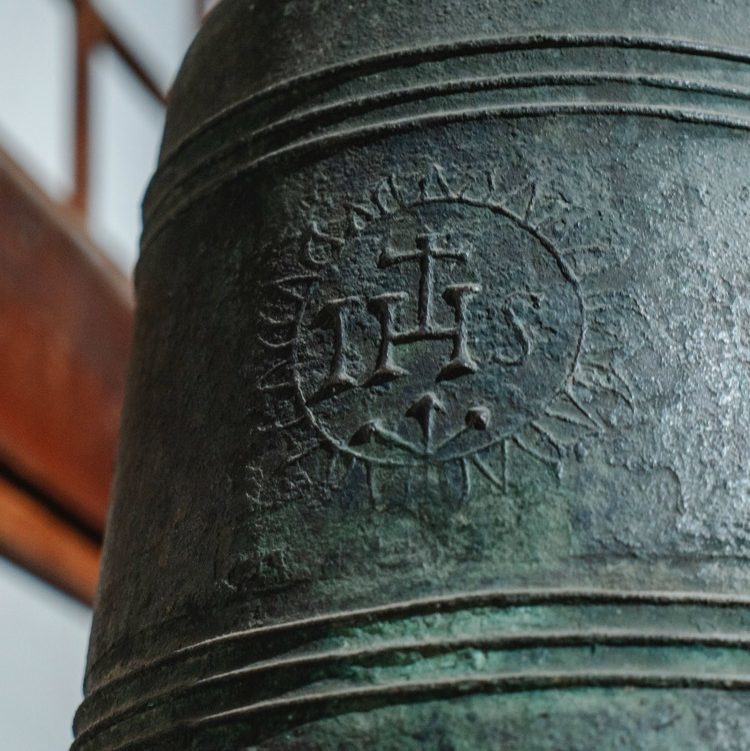
In addition, the bell which is thought to have been hung at Nanbanji Temple is currently hung at Shunkoin Temple at the head of the Myoshinji Temple, and has been designated as Important Cultural Property. It is a European-style copper bell and bears the Jesuit coat of arms, the Christian cross, the letters HIS, and the number 1577. IHS stands for ‘Iesus Hominum Salvaor’ which means ‘Jesus, the savior’ in Latin.