09. Kabuki
Kabuki(TED)
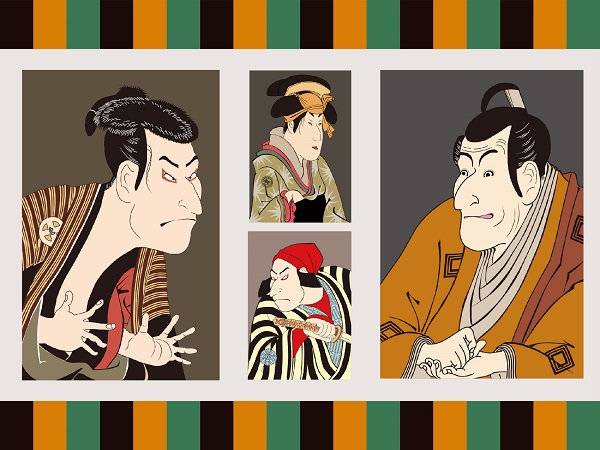
Kabuki
What images come to mind when you think of traditional Japanese performing arts? There are many traditional Japanese performing arts, such as Noh, Kyogen, and Kabuki. Forms of entertainment with music and dance that incorporate seasonal features have been popular in Japan for centuries. In this section, we will focus on Kabuki, which is a popular and casual form of entertainment even today.
1. History of Kabuki
Kabuki became popular when a female Geisha named Izumo no Okuni began performing Kabuki dance in 1603, in the early Edo Period. Due to the popularity, seven government-approved performance houses were opened in Shijo. In her act, Izumo no Okuni acted as a man dressed in a wacky costume. Seeing her success, many other Geisha started imitating her acts, attracting men with dances and songs. However, some kabuki performers started to provide sexual services or prostitution. As a result, Kabuki was outlawed by Edo shogunate in 1629 on the ground that sexual services corrupt public morals. After that, a new form called Wakashu Kabuki performed by young boys between 12 and 18 years old started gaining attention. Wakashu Kabuki itself was established at the same time as female Kabuki, but the ban on female Kabuki diverted fans, and Wakashu Kabuki became very popular. However, this form of Kabuki would also come to be banned by Edo shogunates for the same reason. The young actors also became prostitutes, and Edo shogunates was fixated on rooting out public moral degradation. Wakashu was outlawed just 23 years after female Kabuki.
In this way, female and Wakashu Kabuki were banned. In its place, male Kabuki became popular. Male Kabuki was performed under the agreement that there would be no sexual content and all parts would be played by adult men. This agreement survives to this day, and all current Kabuki is performed by men. Female parts are still played by men. A similar but opposite style of play exisits today, called Takarazuka. All of the performers are women, and male roles are performed by women dressing and acting as men.
Men-only Kabuki was quickly gaining popularity. It was also at around this time that Shakespeare performed at Renaissance theater in the West. While Shakespeare valued story-telling through script, Kabuki valued production. This is manifested in how stylish the play is, and flashy that makeup is. Kabuki includes three elements: acting, dance, and music, and really focuses on entertaining the crowd. The acting in particular is well known for its exaggerated emotional expressions, pursuing beauty and coolness in both the performance and the production.
2. About the Kabuki system
When speaking of Kabuki, the shouts of ‘Narita-ya!’ and ‘Otowa-ya!’ come to mind. These are family group names of the actors on stage and family names are often shouted across the stage. Each actor belongs to a particular family group and has his stage name. This concept of the stage name may be one reason Kabuki is seen as difficult.
First of all, the names of the actors are passed down from generation to generation. Danjuro Ichikawa and Kikugoro Onoue are some famous past actors. The names of these people are now used as stage names for the roles they performed. In fact, the first Danjuro Ichikawa and Kikugoro Onoue passed away a long time ago. Actors active on the Kabuki stage will inherit these names. For example, if Person A was active with the stage name Danjuro Ichikawa the Third, he would pass this name onto Person B when person A died or retired. Then, Person B would become Danjuro Ichikawa the Fourth. Person B does not necessarily have to be from the same bloodline family in order to inherit the stage name. It is a popular misconception the Kabuki is a closed world and you have to be from the same bloodline in order to perform. This is not the case. Anyone can inherit a stage name from an active Kabuki actor. To do this, you will need to become a student of an active performer or enter a traditional performing arts training center associated with the National Theater. After studying Kabuki, Japanese dance, and song for two to three years, and working as an underling on stage, you might be adopted as a full-fledged Kabuki actor if your talents are recognized.
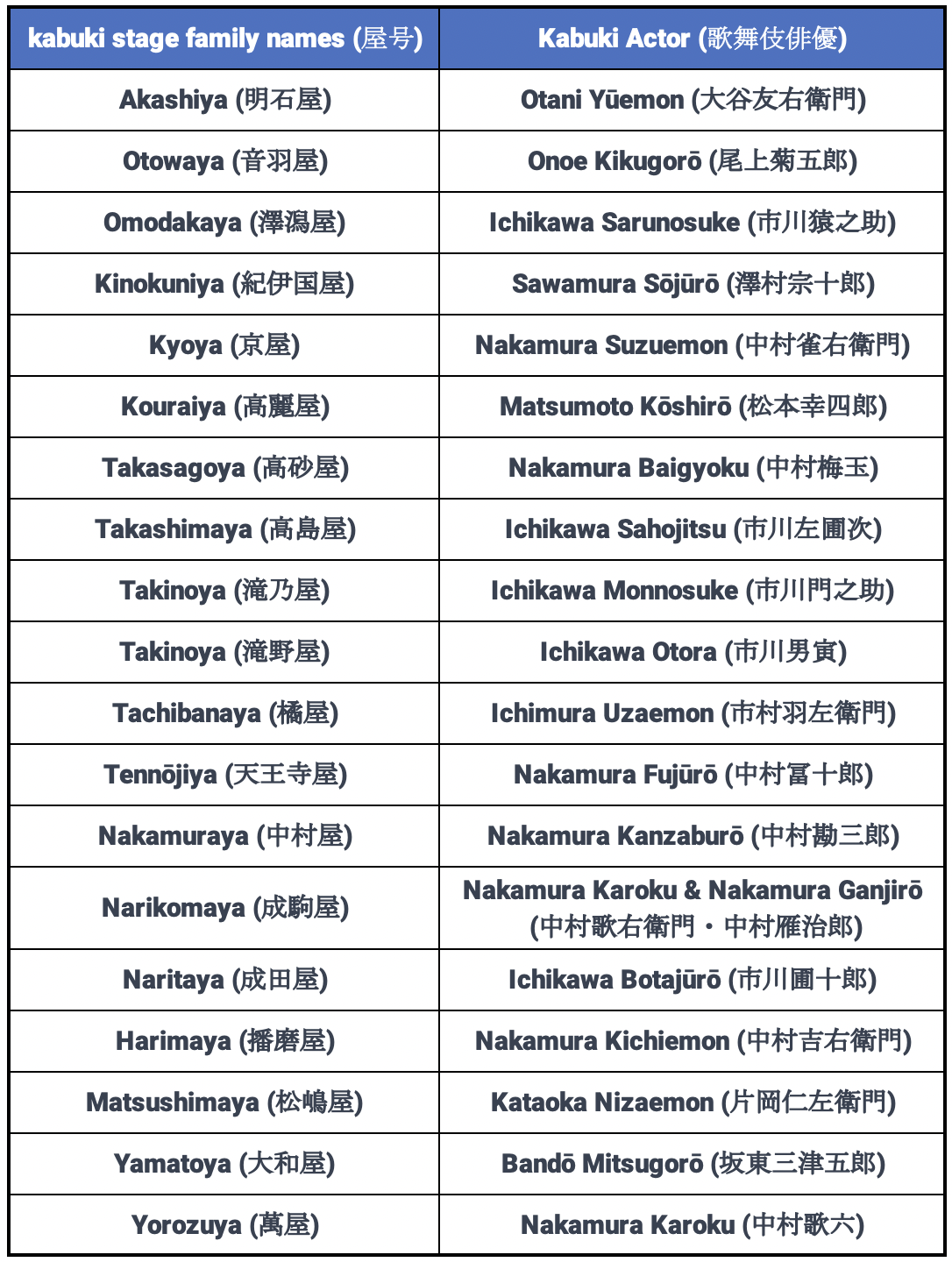
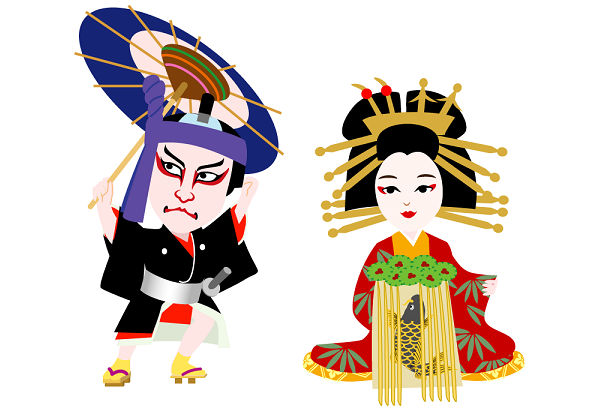
Main House Names and Kabuki Actor Names
3. Major stage group and Kabuki actors
In the Kabuki world, there is no standard system for rating the various stage groups and evaluating which is the best. Generally, stage groups that have been around longer are thought to be more prestigious. In the respect, Narita-ya, with its pedigree going back to Danjuro Ichikawa, is the most respected and prized groups.
Another topic that often comes up is the childhood names of Kabuki actors. Childhood names are the first names given to Kabuki actors that have been on stage as children. For example, Ebizo Ichikawa and Kikunosuke Onoue are a couple of famous Kabuki actors. Their childhood names were Shinnosuke Ichikawa and Yunosuke Onoue. As Shinnosuke grew up, the fans were enthralled with questions like, ‘Will Shinnosuke grow up to become Ebizo?’
4. The Kabuki program
There are two main types of Kabuki, Aragoto and Wagoto. While Aragoto gained popularity in Edo (or Tokyo today), Wagoto was preferred in Kyoto.
On the one hand, Aragoto is a style created by the first Danjuro Ichikawa from the Narita-ya group. It is characterized by violent and dynamic acting. In 1603, Ieyasu Tokugawa terminated Toyotomi clan and political power moved from Kyoto to Edo. There were many male laborers and samurai involved in the new development work. They preferred the masculine Aragoto style. The main character is a brave and dynamic person. The story is simple and clear. They are mainly stories of good heroes that ward off bad guys. ‘ Kanjincho‘, ‘ Shibaraku‘, and ‘ Sukeroku‘ are some legendary Aragoto plays.
In Kabuki, the face is made very white. Back in the days when the stage was lit by candle lit, the stage was quite dim. To make sure the audience could recognize the characters, the actors’ faces were made-up to be white to be easily seen, with exaggerated accents so they could be easily recognized. In addition to that, in the style of Aragoto Kabuki, actor’s face are marked with red, blue, and broun lines. These red or blue accents are called Kumadori. There are over 100 types of Kumadori patterns, each symbolizing a specific characteristic of the character. Red is often used for bloody characters and hero types. Blue is for high-ranking villans, and brown is for goblins masquerading as humans. The Kumadori is an essential part of the performance that helps tell the tale of Kabuki.
On the other hand, the Wagoto style had many softer stories and does not use Kumadori. The main character was a rich a handsome man from the commercial city of Osaka. There are many smaller heroes. They are not as deveiner as the dashing heroes of Aragoto, but they had a charm that the women of Kyoto found irresistible. ‘ Kuruwabunsho‘ is considered a masterpiece of Wagoto Kabuki.
Usually in theaters, there is a director that directs the performers and the production for plays. In Kabuki, there is no such director. The director role is taken over by the leading actor. Since the interpretation of the program is different for each person, the production of the same program is different depending on who is taking the leading role.
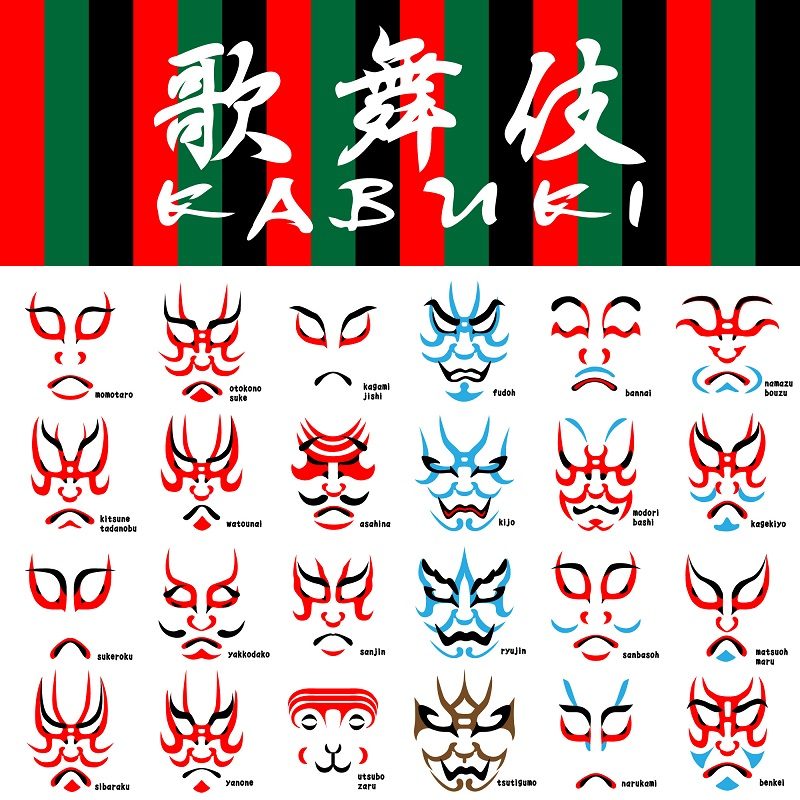
A variety of Kumatori
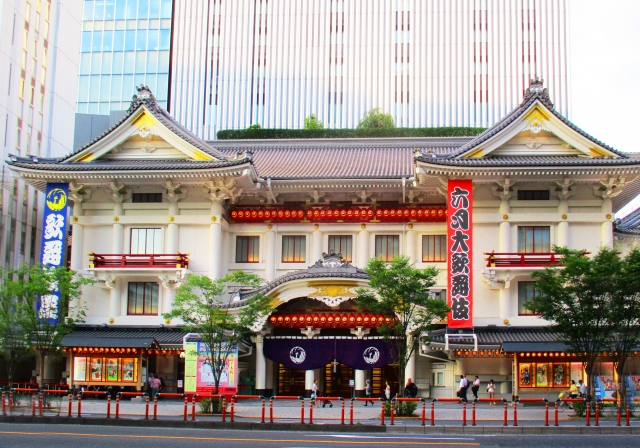
Tokyo Kabuki Theatre
5. Modern Kabuki
Kabuki established itself as entertainment for men and women of all ages. Kabuki continuously incorporated interesting themes and made great efforts to improve its entertainment value. Over the years, that has made Kabuki a very diverse art form. This practice of incorporating new ideas still occurs today. For example, anime culture has been incorporated into Kabuki in recent years. Famous anime such as NARUTO and One Piece have been made into Kabuki plays and performed for enthusiastic audiences. Performances unimaginable in the Edo period, such as flying over the audience using wires, bring new excitement into the world of Kabuki and keep Kabuki fans on the edge of their seats.
Some tourists think Kabuki is too difficult for them to enjoy properly. Why not take a step into the world of Kabuki? There, you will find a vast repository of Japanese culture that has accumulated for over 400 years, and continues to evolve. Especially for first time Kabuki goers, we recommend using audio guides when attending a Kabuki performance. As the program progresses, the audio will explain the contents, highlights, and the significance of the costumes and props. These audio guides have received high praise for their easy listening style. Interviews with actors and detailed explanations of the performances are broadcast during the breaks. In this way, even those not familiar with Japanese language or culture can enjoy one of Japan’s essential cultural art forms.