05. Traditional entertainment in Japan
Maiko @Gion (NHK:Youtube)
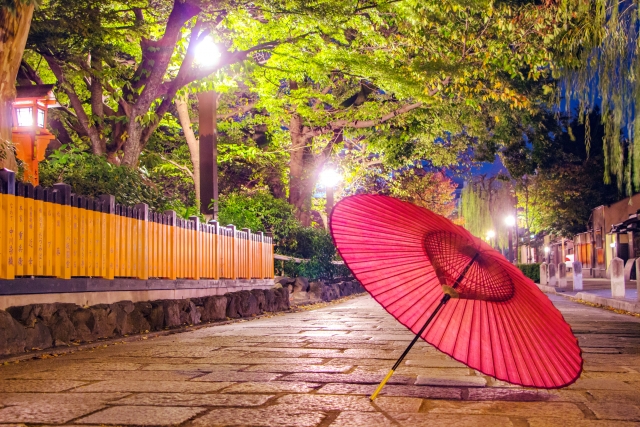
Hanamachi is a liesure district where Geishas and Maikos attract their customers with dancing and singing. Hanamachi is a Japanese word and one of the most important traditional entertainment areas in Kyoto. Geishas and Maikos are both women that perform arts at banquets. Although there are similar leisure districts in some prefectures such as Tokyo, Nagoya, Kanazawa and so forth, Kyoto’s Hanamachi standout because they have ‘Maiko’. Maikos are girls who are apprenticing to become Geisha. You can only see them in Kyoto.
1. Geishas
When speaking of Geisha, American film ’Memoirs of a Geisha’ might come to mind. Although the story of young peasant girl sold as servant and apprentice to a renowned geisha house around world war 2, Maiko and Geisha are still existing today. Geishas are trained in various arts such as dancing and shamisen (three-stringed Japanese banjo), and perform them for customers to enjoy their art and conversation. It is also important to hone how to interact with guests, be knowledgeable about a wide variety of topics, and maintain attractiveness. Geishas wear wigs with almost no decoration or ornaments, and a black or plain kimono. On their feet, they wear low-bottomed slippers and sandals. Geishas are self-employed. They must look for their own work and make a living for themselves.
2. Maikos
On the other hand, Maikos refers to girls who are in training to become Geishas. To become a full-fledged Geishas, it is important to continually improve skills such as singing and dancing, and playing the shamisen. In general, girls can start a period of apprenticeship at the age of 15, after they finish junior high school, and become Maikos. Girls wanting be become Maikos can enter the okiya after graduating from junior high school. Some girls even commute to high school from their okiya. The okiya covers all of their food, kimono, lessons and other expenses during their training. There are no costs for the Maikos until she becomes a Geisha. After about five years of training as a Maiko, they can become a Geisha.
3. The six Hanamachis Kyoto
Hanamachis are districts Geishas and other entertainers dance and perform music and other arts. Kyoto has six Hanamachis (Gion Kobu, Miyagawa-cho, Ponto-cho, Kamishichiken, Gion Higashi and Shimabara). Hanamachis started out as a tea house that offered refreshments to worshippers returning from Shrine. Over time, the tea house evolved into a place for entertainment. The area became dense with many such establishments, and became a ‘Hanamachi’.
The six Hanamachis in Kyoto
Gion Kobu: Originally a tea house for worshippers located near the gates to Yasaka Shrine. The old townscape has been preserved and this area is popular with tourists.
Miyakawa-cho: Wakashu Kabuki (group of young boys doing Kabuki) popularized Kabuki in this area. Then, brothels formed. Today, it is a model Hanamachi.
Ponto-cho: A sandbar on Kamogawa River was reclaimed and lodges and tea house lined up on the newly created land, forming a Hanamachi. The narrow alleys have a very unique, Kyoto-like feel.
Kamishichiken: Seven tea houses were built from the construction materials left over from the reconstruction of the Kitano Tenmangu Shrine during the Muromachi Period. These tea houses made of scraps prospered into a Hanamachi of the Nishigin area.
Gion Higashi: Located in the northeastern corner of Gion Town, it was originally called Gion Otobe, countering Gion Kobu. After World War II, it became known as Gion Higashi.
Shimabara: At the beginning of the Edo period when Kabuki became popular, this area was the only place in Kyoto with brothels licensed by the Shogunate. The end of the Edo Period brought the end of official recognition of brothels. Only a few remnants of the past are visible today.
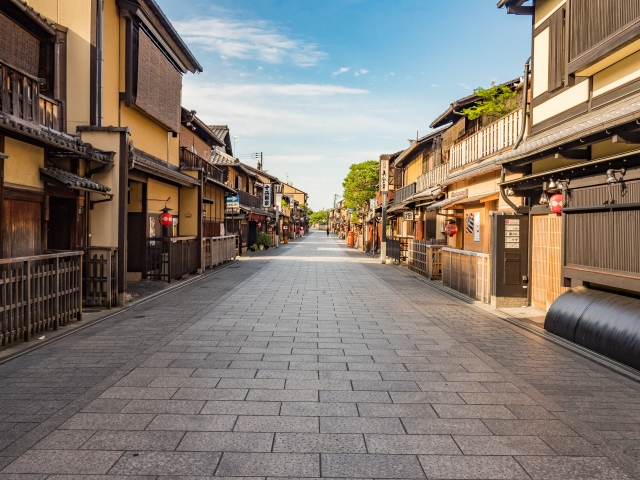
Hanamikoji Street
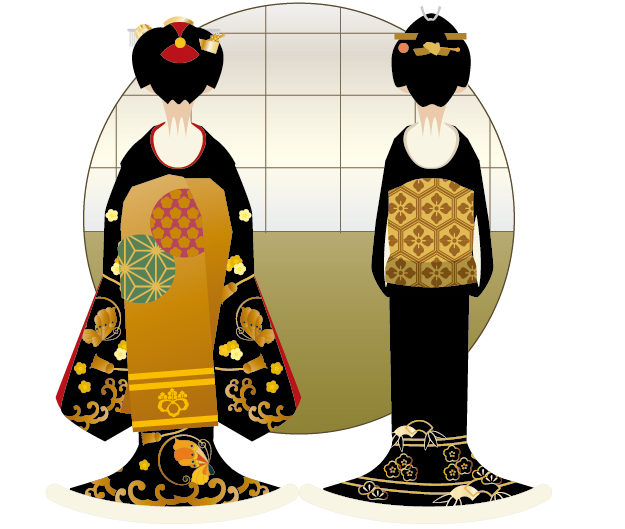
Maikos (Left) and Geishas (Right)
4. Hanamachi and heroes of history
Kyoto’s Hanamachi were vibrant places that many historical figures visited throughout Japanese history. When the Edo period (which lasted 260 years from 1603) was coming to a close, Takayoshi Kido and Ryoma Sakamoto were trying to overthrow the Edo Shogunate, and Isami Kondo of Shinsengumi who was trying to protect it, both held many secret meetings in the Hanamachi of Kyoto. More details of the Shinsengumi can be found on a separate page. They fought valiantly to protect the Edo Shogunate. Many of them were young men in the 20s and 30s. Inevitably, romances would flair up, and they would fall in love with Maikos and Geishas. The two most famous figures from this era are Takayoshi Kido and Ikumatsu. Ikumatsu was a Geisha. She was devout and helped Takayoshi Kido escape attempts on his life. The inn where it occurred, called Ikumatsu Inn, still exists today. If you visit, you can still see the place Ikumatsu hid Takayoshi Kido from the enemy. Returning to the Shinsengumi, Isami Kondo, the general of the Shinsengumi was particularly so fond of women that his colleagues referred to him as a ‘woman-loving baboon.’
5. Origins of Gion
When Japanese
people hear about Maikos, Geishas, and tea games, they would think of Gion. Gion originally developed as a town surrounding the main gate of Yasaka Shrine in the early 13th century, at the beginning of the Kamakura Period. In the Edo Period, as the number of worshippers increased, lines of tea houses began to form. Extensive anti-erosion work was done on the Kamogawa River in 1670. This created a lot of new land, triggering an explosion of Hanamachi expansion along Shijo street and to the north. By the end of the Edo Period, a huge Hanamachi had formed, with more than 700 tea houses and 3,000 Maiko and Geisha working them. The growing number of tea houses also promoted division of labor, leading to the current arrangement of tea houses, okiyas, and restaurants, each with their own important roles in the system. Originally, most tea houses in Hanamachi were located on the north side of Shijo
street. A strong wave of modernization in this area forced Gion Hanamachi to relocate to its current location.
After Edo shogunate returned its power to the Emperor in 1867, under the Emperor Meiji government got power and implemented drastic modernization called ‘Meiji Restoration’. At that time, Meiji government moved the capital of Japan from Kyoto to Tokyo. Due to the political change in Kyoto, the economy had got deteriorated. In order to improve the situation, Kyoto city introduced Kyoto city electric tram
across Kyoto in 1912. Higashioji street and Shijo street
were greatly widened and trams tracks were laid. It is true! With the installation of the trams system, Hanamachi was forced to reorganize and relocate.
Hanamachi is simply an area of town with a high density of tea houses. Of course, there are many entertainment industries such as Maiko and Geisha, but prostitutes that provided sexual services were also present
in some tea houses. It was also the place of yuyaku, or brothels. As urban development progressed and the laying of tram networks expanded the city, many citizens were able to travel to Shijo street, and it was thought that exposing so many citizens to the
sexual services of Hanamachi was not good for the morals. So, the Meiji government set out to relocate Hanamachi to outside of city limits. They prohibited the operation of tea houses along Shijo street. The tea houses had no option but to relocate. An area to the south of Shijo street was chosen as the new location. The area was marshy and thick with bamboo, and was the location of the
Kenninji Temple until the Edo Period. Kinnenji was a vast temple, stretching from present-day Minamiza all the way to the Yasaka Shrine area. Of course, buildings cannot be built on marshes. The marsh was filled in with ground raising work, and the tea house district finally relocated
on the mound. Even today, you can see the
ground raising work carried out centuries ago.
Gion corner
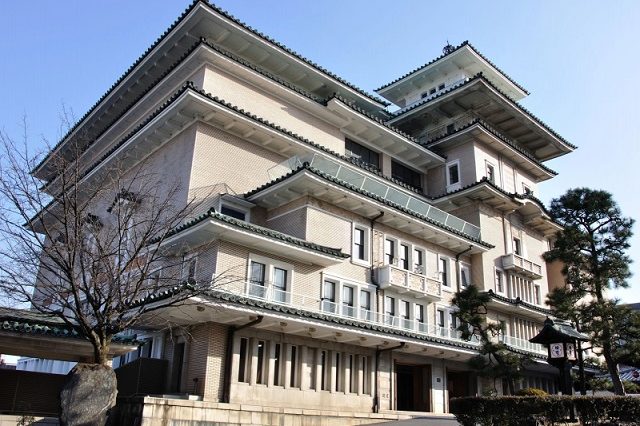
Gion corner
6. How to enjoy a Hanamachi tea house
Here is a brief explanation of how to enjoy your time at a Hanamachi tea house, through different types of ‘asobi’, or play. The history of tea houses goes back over 300 years. It all started with female servers that worked at the tea houses. In the beginning, they brought tea to people who had come to visit the shrines and temples. Over time, the tea turned liquor. And the service evolved from just bringing tea to include singing and dancing.
These days, people enjoy tea houses by inviting Maiko and Geisha to the dining spaces for them to sing, dance, and enjoy conversation. The payment for inviting Maiko and Geisha does not include the cost of food and drinks. There are no standard price lists for your time at a tea house. Costs depend on the tea house and the style of the customer.
The hospitality provided by Hanamachi does not end with the services provided by the Maiko and Geisha. It is a unique culture in which even the guests are involved in the ‘asobi’ to bring about a peaceful, relaxing atmosphere. There are many different types of asobi, from games like konpirafunefune and toratora which use shamisen. Of course, the stars of such tea houses are the Maiko and Geisha. But this is all made possible by the Okiya, who houses them, teaches them the games and customs, and dispatches them to tea houses that request them. Okiya are like the entertainment production companies.
In addition to all of this, the tea house system is also aided many other people, such as restaurants that serve banquet meals and master craftsmen who make the tools and props used by the Maiko and Geisha. And one of the greatest things about the entire tea house system is the role of the tea house itself. The tea house not only line up Maiko and Geisha from the Okiya, they also provide any other services that a guest might need, such as arranging food and drinks, preparing the dining hall, and even arranging lodging and transportation. The tea house brings the whole production together. All of these services are paid for by the tea house, and guests reimburse them later. Therefore, guests do not need to think about money on that day. They are able to enjoy their time without being bothered about bills.
Guests pay for their time at the tea house at a later date. This means that, only people that are familiar to the tea house can be entertained there. ‘First timers not welcome’ is a common phrase in the tea house world. In order to go to a tea house, you must first be invited by someone that already has access to a tea house. After you visit several times as someone’s guest, you might be able to gain the trust of the owner. Only then will you be allowed to visit the tea house by yourself. Paradoxically, this unfriendly stance of rejecting strangers leads to a higher level of hospitality for guests who have become close with the owners of the tea houses.
7. Experience traditional Japanese culture in Gion
The
Kabuki theater in Gion Kobu is a place where Maiko and Geisha from the area still practice and present Kabuki songs. Every year, it conducts onstage performances of ’
Miyako Odori’ of Gion Kobu. In addition, consider visiting the
Yaei Kaikan right next door. There, you will find the Gion Corner where you can see seven traditional performing arts all at once, such as the
tea ceremony,
flower arrangement,
koto music,
court music and dance,
kyomai-dance,
Kyogen Theatre, puppet theater. It is a very popular facility for tourists as they are able to enjoy a wide range of Japanese traditional arts in about one hour.